Few-shot cross-subject EEG cognitive load assessment based on global cross-attention domain adaptation (2025)
Open in webOpen in zoteroOpen pdf
1 Abstract
Cognitive load (CL) assessment is crucial for optimizing human-machine interaction (HMI), enabling dynamic task allocation and efficient coordination between human and machine resources to enhance adaptability and performance. Electroencephalography (EEG), as a key physiological signal captured via wearable electrodes, provides objective evidence for real-time and accurate CL monitoring. However, cross-subject variability and the difficulty of collecting labeled EEG data pose significant challenges to reliable CL assessment. Existing methods are limited by their reliance on large-scale labeled data and their tendency to compromise shallow features during domain alignment. To address these limitations, we propose the Global Cross-Attention Aligner (GCA), a novel domain adaptation framework that improves cross-subject EEG-based CL assessment using only 1% of labeled target data. GCA employs a cross-attention mechanism to preserve crucial shallow features while aligning conditional distributions across domains. Combined with a source domain selector and adversarial training, it achieves state-of-the-art accuracy (78.76%–98.20%) on five public datasets and our self-collected dataset, outperforming baselines by over 3%. This work advances adaptive HMI systems driven by wearable sensors and promotes few-shot learning in EEG-based brain-computer interfaces (BCIs). Code will be available after acceptation.
2 NOTES
In this work the authors propose the architecture of the following image as for the problem of cross-subject domain adaption in for cognitive load prediction.
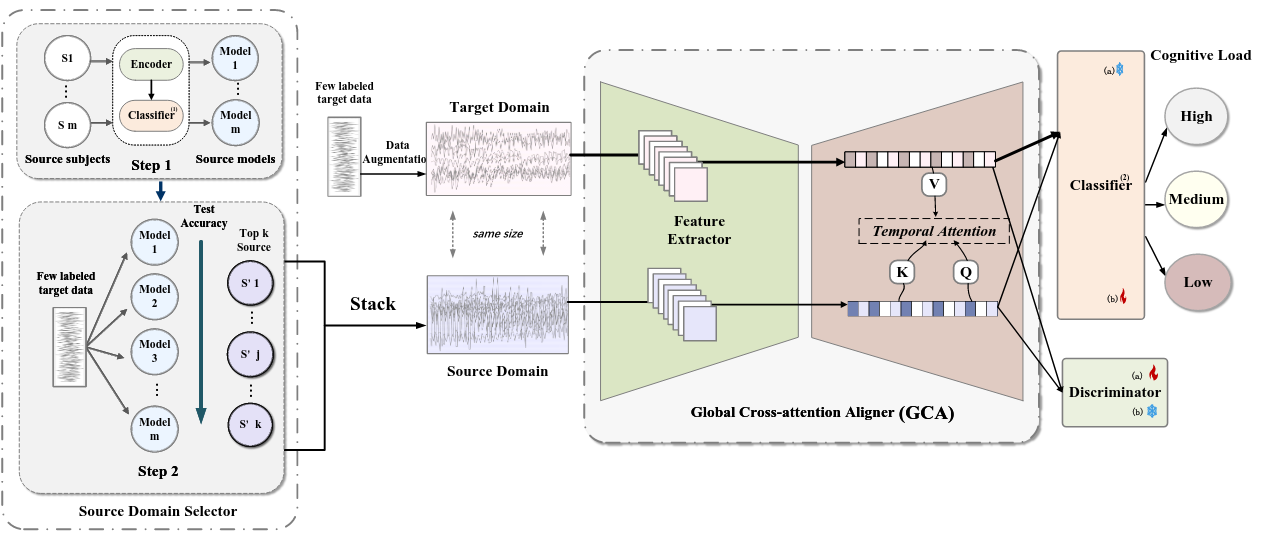
I really like the Source Domain Selector, the idea is that after training one model per subject (with a simple mlp) he can use them to classify the target data, and the ones that give the higher accuracy are probably the ones that have a similar distribution. These subjects from these model are used to form an optimized source domain list.
The second thing that is interesting is their use of the Temporal Attention, where they use the source domain data to extract they Queries and Keys, while the Values are extracted from the target domain. They also mention only using the decoder part of the MHA, which I don’t understand but seems relevant. The table bellow shows the details of the architecture:
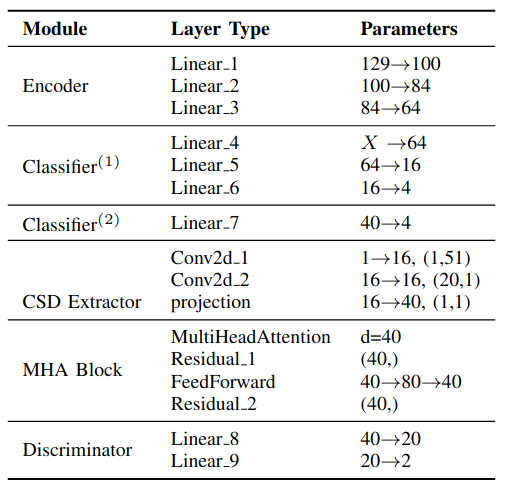
While I do have plenty of issues with their results (seems too good to be true), the paper does present some nice ideas. But it is hard to understand the whole thing since they don’t present the code. So, I don’t recommend this paper.