Transfer Learning for Covariance Matrix Estimation: Optimality and Adaptivity (2024)
Open in webOpen in zoteroOpen pdf
1 Abstract
Transfer learning, which leverages knowledge from an auxiliary source dataset to improve performance in a primary target domain, has emerged as a pivotal machine learning technique. In this paper, we consider minimax and adaptive estimation of large bandable covariance matrices within the transfer learning framework.
We first establish the minimax rate of convergence under the spectral norm and propose a rate-optimal estimation procedure. Our findings reveal intriguing phase transition phenomena that highlight the effectiveness of transfer learning and the use of source samples. We then address the problem of adaptation, establishing the adaptive rate of convergence up to a logarithmic factor. Our results demonstrate that, in sharp contrast to conventional settings, the cost of adaptation in transfer learning can be substantial in certain cases. We propose a novel data-driven algorithm that dynamically adapts to unknown model parameters. These theoretical insights are further validated by a simulation study, demonstrating the practicality and efficiency of the proposed adaptive algorithm. Also, the authors cite 9 of their own works, and some that seem very similar from the early 2010s, which is quite sketchy.
2 NOTES
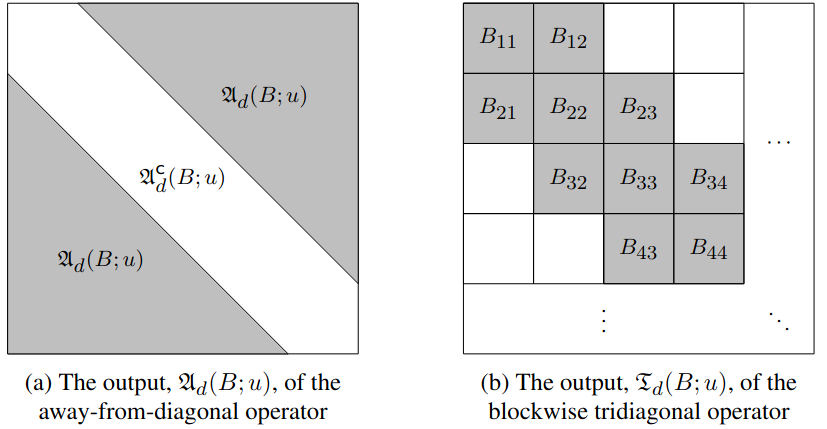
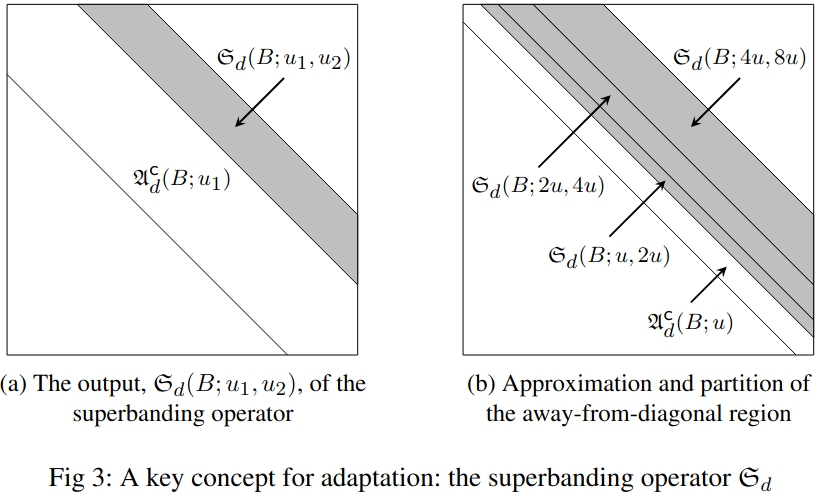
The authors propose an adaptive tridiagonal block-thresholding estimator, achieved using minimax rate. I didn’t really understood much of the paper, nor gave enough time reading time. However, their use of the blockwise tridiagonal operator is very interesting, they apply it to a chosen sample covariance matrix, retaining only the main, super, and subdiagonals from a blockwise standpoint. This approach is logical, considering the bandable structure of the covariance matrix. Given that the bandable structure implies a geometric decay of the away-from-diagonal part, it is logical to truncate the sample covariance matrices using the blockwise tridiagonal operator. the individual blocks generated by the operator can preserve a low-dimensional nature. The previous sentences were extracted directly from the paper, but they are understood easily by the following figures, showing ways in which we could reduce the size of the matrix based on the relevance of closer electrodes. Overall, its a complex paper, and without their implementation I think it is also quite hard to reproduce, but this idea of extracting blocks and sections from the bandable matrix is very relevant.