Riemannian fusions of EEG-based features for motor imagery detection under propofol sedation ()
Open in webOpen in zoteroOpen pdf
1 Abstract
The brain is a complex system requiring multimodal approaches to better understand cognitive or motor functions. Thus, different and complementary electroencephalographic (EEG) neurophysiological features are available at various spatial, frequency, and temporal scales, e.g., brain connectivity, complexity, or entropy. However, they are usually not investigated all together. In this study, we combine and compare five EEG-based connectivity features with covariance matrices, defining five Riemannian fusion methods and three Euclidean ones as references. We do so for classifying motor imagery EEG signals, both in awake and sedated subjects, with the future goal of detecting accidental awareness during general anesthesia. Covariance matrices alone yielded the best accuracy, with and without sedation. Phase-based connectivity estimators appear to be the most promising fusion with covariances. No significant differences were found between the best fusion of features and that of classifiers.
2 NOTES
- Why do they choose to use the Bradley-Terry model in specific? They mention it is to rank discriminative power of each feature set by using pairwise comparions, but is still uncertain why this is better.
This study mainly explore the possibility of combining EEG-based connectivity features with covariance matrices, and also using euclidean vs Riemannian classifier vs their fused combinations. The paper is weird, I found quite confusing what they were fusing and how, specially regarding the classifiers. But what they used is:
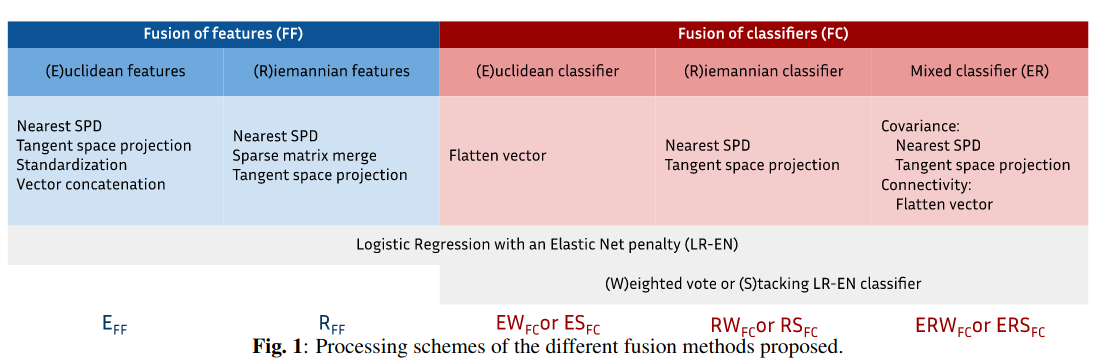
Still, what is most interesting is that covariance matrices exhibited the highest discriminative power, yielding a higher accuracy then coherence and phase-based features. Also, when fusing, the best results were not by creating a block matrix (which turns out to be sparse), but rather fusing them on the tangent space. It kinda makes sense, since this will reduce repeated features (due to symmetry) and sparsity.
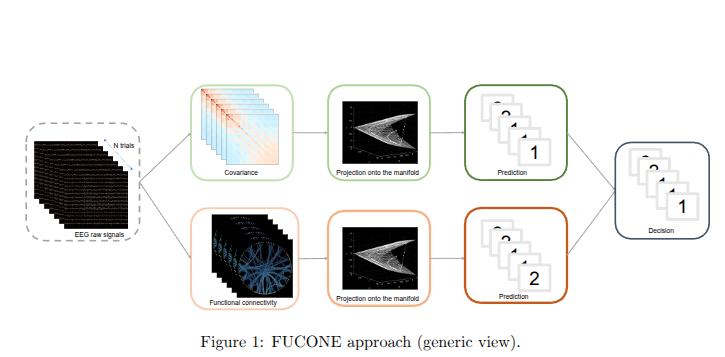
Their idea of fusing the classifier is the one shown in the Figure bellow. They have essentially three classifiers, where two form the first-level classification (in here they saw that projecting both to the tangent space is the best direction) and then a second-level where the decision is made. From this they obtained that “[…] the best mixed result is achieved in the weighted (Euclidean+Riemann+Weighted vote) method using classifiers trained on covariance and PLV (69.74%), while the best purely Riemannian result is obtained with (Riemann+Stacking Ensemble based on LR-RN) using covariance and imaginary coherence (68.41%).”.