Classification of image encoded SSVEP-based EEG signals using convolutional neural networks (2023)
Open in webOpen in zoteroOpen pdf
1 Abstract
Brain–Computer Interfaces (BCI) systems based on electroencephalography (EEG) signals are experiencing a rapid development, counting with a number of methods, mainly from signal processing and machine learning areas. Although important results have been achieved, a robust performance is still a very challenging task, mainly considering high intra- and inter-subject variability in EEG data and long acquisition time intervals. Recently, Deep Learning methods, such as the Convolutional Neural Networks (CNNs), are being used in BCI systems in search of a performance improvement. However, the straightforward use of EEG data, without any processing step, may limit the full potential of 2D-kernels in CNNs. In light of this, in this work, we consider for classification with 2D-kernel-based CNNs the problem of encoding EEG data to images as a pre-processing stage, which includes the Gramian Angular Difference and Summation Fields, Markov Transition Fields and Recurrence Plots. Additionally, a comparative analysis using a selection of CNNs is performed. Results show a favorable performance for the proposed method, pointing towards a robust BCI system using cross-subject data, with short acquisition time interval.
2 NOTES
In this paper the authors propose the use of imaging techniques to transform the EEG data into images by four means: GADF, GASF, MTA and Recurrence. However, before applying to the EEG data, they first use CCA to obtain the projections of the data, which they then concatenate to form a single time series, which is then converted to image, that is:
- EEG Data → Filter → CCA → Projection → Flatten → Image
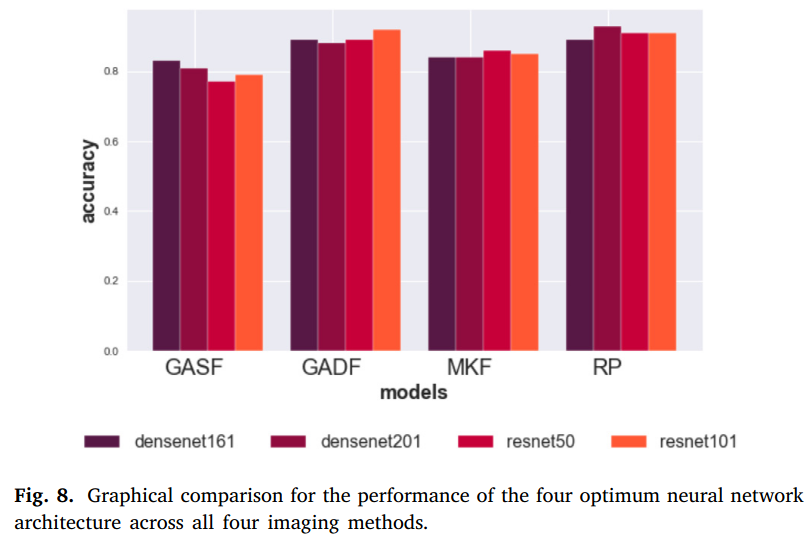
To classify this data they used ResNet, DenseNet, GoogleNet and AlexNet. They also used the EEGNet and ShallowFBCSPNet, but since they do not accept images as input they simply passed the CCA projection.
That said, the best results were with the GADF and RP methods, with RP reaching the best accuracy using the DenseNet161 () followed by the ResNet50 (). These results are shown bellow
Overall it is a nice paper, but I think the results are way too high, I wonder if there is really no data leakage.