Feature Selection via Dynamic Graph-based Attention Block in MI-based EEG Signals (2024)
Open in webOpen in zoteroOpen pdf
1 Abstract
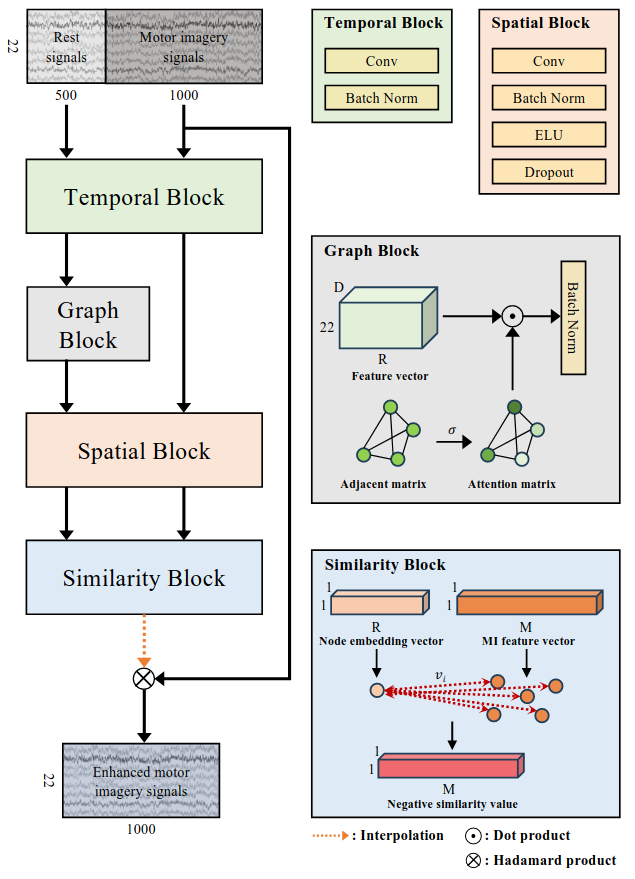
Brain-computer interface (BCI) technology enables direct interaction between humans and computers by analyzing brain signals. Electroencephalogram (EEG) is one of the non-invasive tools used in BCI systems, providing high temporal resolution for real-time applications. However, EEG signals are often affected by a low signal-to-noise ratio, physiological artifacts, and individual variability, representing challenges in extracting distinct features. Also, motor imagery (MI)-based EEG signals could contain features with low correlation to MI characteristics, which might cause the weights of the deep model to become biased towards those features. To address these problems, we proposed the end-to-end deep preprocessing method that effectively enhances MI characteristics while attenuating features with low correlation to MI characteristics. The proposed method consisted of the temporal, spatial, graph, and similarity blocks to preprocess MI-based EEG signals, aiming to extract more discriminative features and improve the robustness. We evaluated the proposed method using the public dataset 2a of BCI Competition IV to compare the performances when integrating the proposed method into the conventional models, including the DeepConvNet, the M-ShallowConvNet, and the EEGNet. The experimental results showed that the proposed method could achieve the improved performances and lead to more clustered feature distributions of MI tasks. Hence, we demonstrated that our proposed method could enhance discriminative features related to MI characteristics.
2 NOTES
In this paper the authors propose an EEGNet-base neural network that has to differences: its use of the “rest” signal and of a graph-based convolution layer. The first is very interesting, since it is a portion of the signal that may be useful but many authors usually cut it of. However, it is also the only portion that the authors in here apply the graph block. They are trying to identify similarities (with negative cosine similarity method) from rest with motor imagery, which doesn’t make much sense. Or rather, maybe it does, maybe by doing so it is possible to remove certain artifacts, such as eye movements, which should be removed. Their results showed that both DeepConvNet and M-ShallowConvNet had better results with this additional “branch” (for rest state) but EEGNet did not improve. They mention that it could be due to the fact that EEGNet doesn’t have many parameters and therefore is limited, however I don’t really think so. The architecture is probably just not great, but has a nice idea, which could certainly be improved by extending the graph to the motor imagery states (for instance). It is a shame that it doesn’t have a GitHub repository page, but it is not a bad paper, it is quite short and explain all that it has to.