Cross-Subject and Cross-Montage EEG Transfer Learning via Individual Tangent Space Alignment and Spatial-Riemannian Feature Fusion (2025)
Open in webOpen in zoteroOpen pdf
1 Abstract
Personalized music-based interventions offer a powerful means of supporting motor rehabilitation by dynamically tailoring auditory stimuli to provide external timekeeping cues, modulate affective states, and stabilise gait patterns. Generalisable Brain-Computer Interfaces (BCIs) thus hold promise for adapting these interventions across individuals. However, inter-subject variability in EEG signals, further compounded by movement-induced artefacts and motor planning differences, hinders the generalisability of BCIs and results in lengthy calibration processes. We propose Individual Tangent Space Alignment (ITSA), a novel pre-alignment strategy incorporating subject-specific recentering, distribution matching, and supervised rotational alignment to enhance cross-subject generalization. Our hybrid architecture fuses Regularized Common Spatial Patterns (RCSP) with Riemannian geometry in parallel and sequential configurations, improving class separability while maintaining the geometric structure of covariance matrices for robust statistical computation. Using leave-one-subject-out cross-validation, ITSA demonstrates significant performance improvements across subjects and conditions. The parallel fusion approach shows the greatest enhancement over its sequential counterpart, with robust performance maintained across varying data conditions and electrode configurations. The code will be made publicly available at the time of publication.
2 NOTES
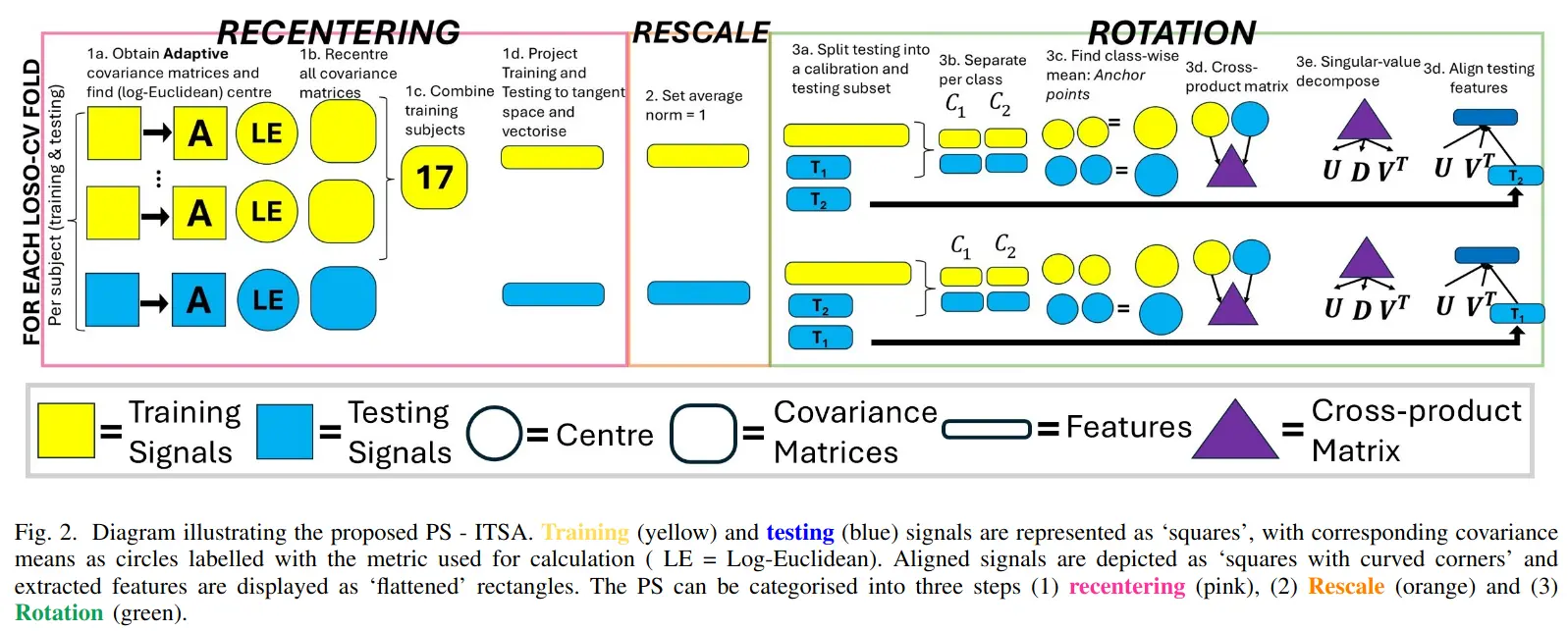
The main proposal here is the Individual Tangent Space Alignment (ITSA) , which is very close to what Pedro Rodrigues does with Riemannian Procrustes Analysis (RPA), as can be seen in the figure below: Input → Recenter → Rescale → Rotate.
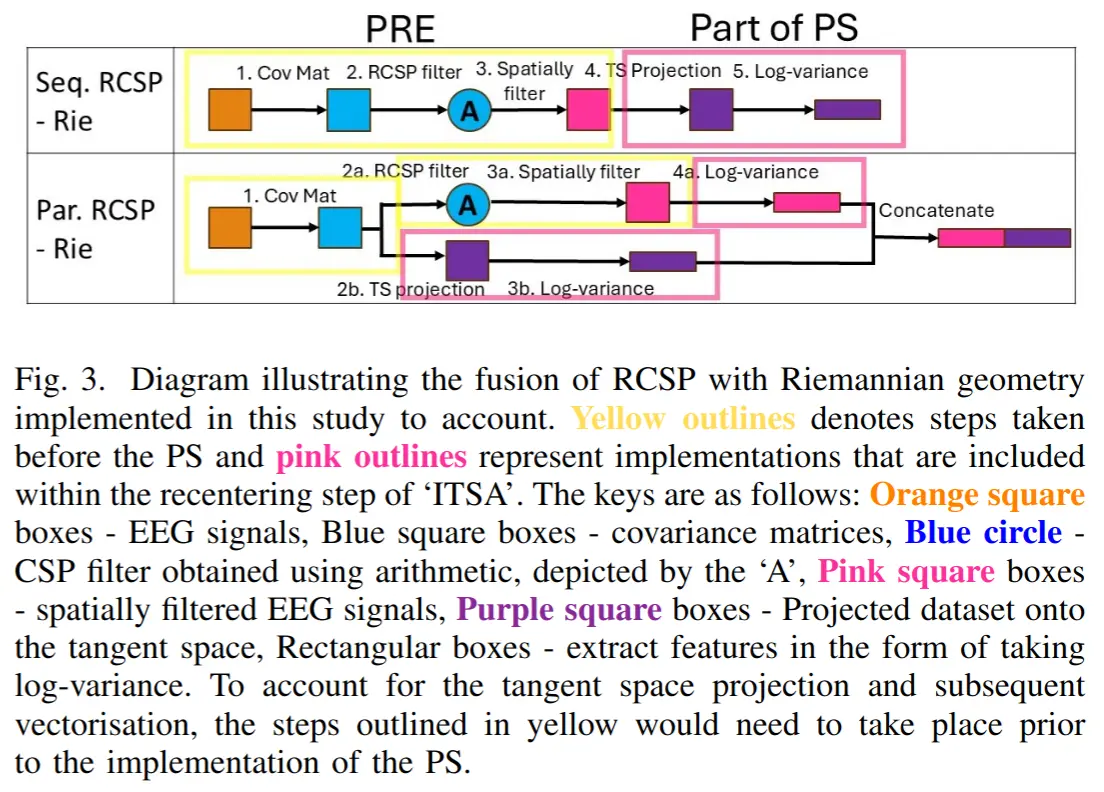
Then they set-up two pipelines for feature generation. Honestly, this is very confusing. But the thing is simply that they obtain a covariance matrix, use diagonal loading to regularize it. Then, they use Riemannian CSP to filter it (which should the both 2. and 3. on the figure below?). The TS Projection and Log-variance are the whole thing from above it seems.