Memory-augmented-based meta-learning framework for cross-subject motor imagery classification (2025)
Open in webOpen in zoteroOpen pdf
1 Abstract
Brain-computer interfaces (BCIs) offer a groundbreaking avenue for facilitating communication between the human brain and external devices. Particularly, motor imagery (MI)-based BCIs have shown potential in various applications such as assistive technologies and rehabilitation. However, the challenge of cross-subject variability remains a significant hurdle for the widespread adoption of BCIs, as it affects the generalization capability of these systems to new subjects. In this work, the memory-augmented-based meta-learning framework is proposed, which integrates the Echo State Network (ESN) with Model-Agnostic Meta-Learning (MAML) to address the issue of cross-subject variability in MI-BCI classification, named as MAgML. The proposed framework utilizes processing power of the parallel ESNs. It captures the rich temporal dynamics of Electroencephalogram (EEG) signals and combines this with attentional mechanisms to enhance prolonged feature acquisition. Additionally, the MAML is employed to quickly adapt to new subjects with minimal calibration. The results demonstrate the effectiveness of them on multiple EEG datasets, and the MAgML outperforms existing methods. On the BCI-2A dataset, the results show MAgML has an improvement with 4.3 % over the best-performing method on 1 shot scenario, and 8.4 % on 20 shots scenario. On the BCI-2B dataset, the improvement ranges from 4.3 % (with 1 shot) to 6.6 % (with 20 shots). The MAgML provides a robust zero-calibration solution for practical and efficient BCI applications.
2 NOTES
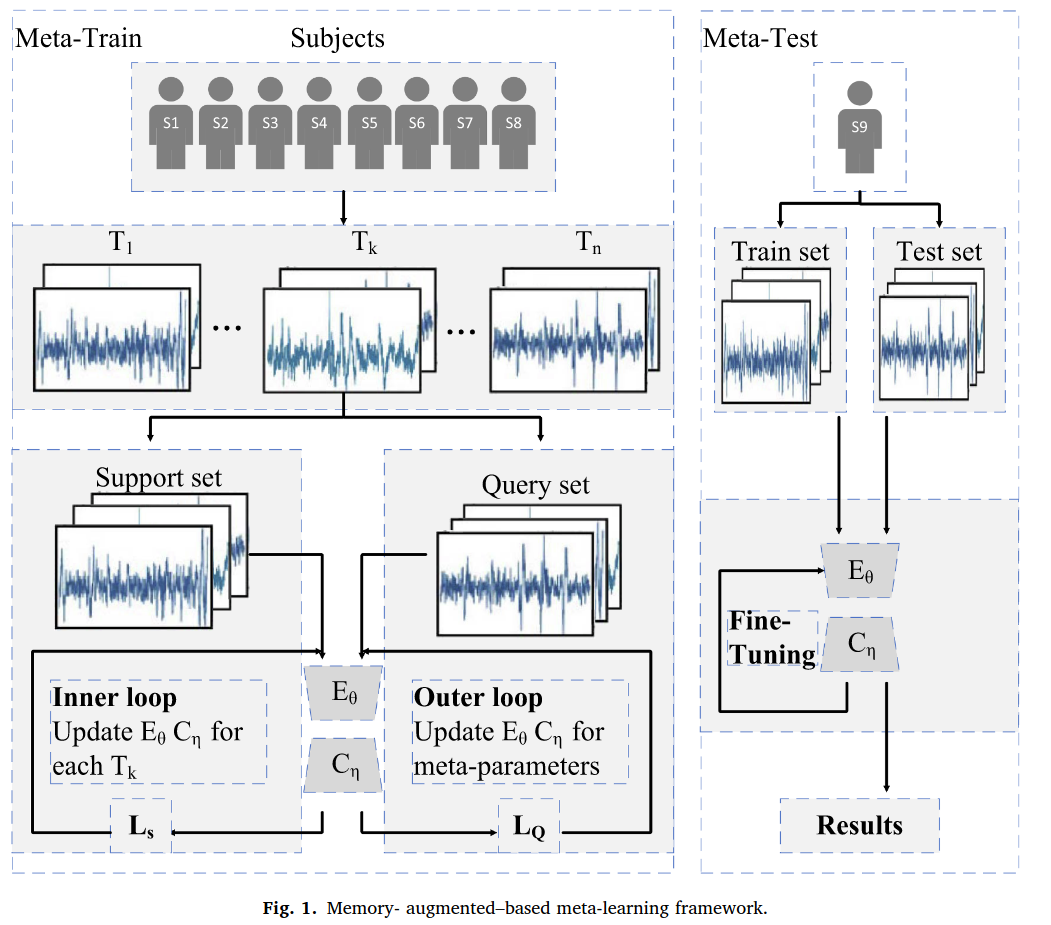
In this work the authors propose a network, with a specific workflow, based on the idea of meta-learning as a way to train a model for cross-subject usage. They define the tasksas being the subjects, therefore one subject is left out (called the meta-test dataset) and the training occurs with the others (with one also being left out to be used as validation). They also split the data from these subjects, forming a support set and a query set (the first being smaller, composed of 4 samples from each subjects, and the second of 8 samples from each). Their explication on how the training occurs is pretty bad, it seems that it updates the model first based on the support set and then afterwards update it based on the query set. But I’m not sure, it is weird. What is interesting is their use of few-shot learning, where they compare the use of 1, 5, 10 and 20 shots (which I believe are the number of samples per class from the test subject). This shows that even with a 1-shot (fine-tuning) the model already perform others models that require as much as 5, 10 and even 20 samples. That is it. There is no code and I found the explanations bad, can’t recommend it.