Riemannian Geometry-Preserving Variational Autoencoder for MI-BCI Data Augmentation (2026)
Open in webOpen in zoteroOpen pdf
1 Abstract
This paper addresses the challenge of generating synthetic electroencephalogram (EEG) covariance matrices for motor imagery brain-computer interface (MI-BCI) applications. Objective. We aim to develop a generative model capable of producing highfidelity synthetic covariance matrices while preserving their symmetric positive-definite nature. Approach. We propose a Riemannian geometry-preserving variational autoencoder (RGP-VAE) integrating geometric mappings with a composite loss function combining Riemannian distance, tangent space reconstruction accuracy and generative diversity. Results. The model generates valid, representative EEG covariance matrices, while learning a subject-invariant latent space. Synthetic data proves practically useful for MI-BCI, with its impact depending on the paired classifier. Contribution. This work introduces and validates the RGP-VAE as a geometry preserving generative model for EEG covariance matrices, highlighting its potential for signal privacy, scalability and data augmentation.
2 NOTES
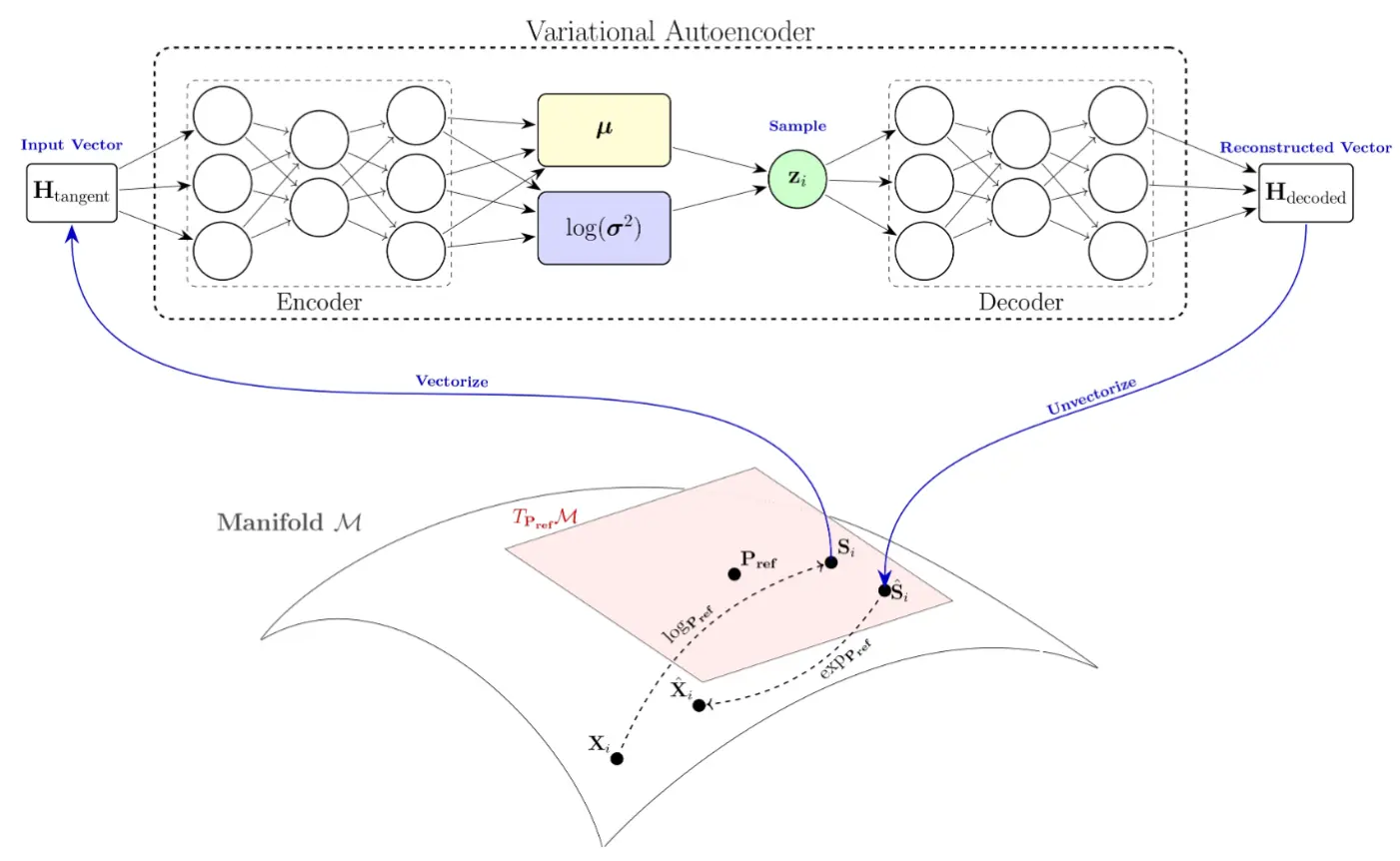
In this paper the authors propose a VAE that receives as input the tangent vector obtained from a covariance matrix. This is then fed to an encoder, that consists of five sequential blocks (linear → batch normalization → LeakyReLU) with dimensions , followed by two separate linear projections to produce where . At the end the reconstructed vector is converted again into a covariance matrix and can be classified by something like RMDM. There are a couple of things to keep an eye here that are interesting:
- For projection into and back from the manifold, the authors use the reference matrix as the karcher’s mean of the training class;
- They train, for each fold, class-specific RGP-VAEs, which explains how they can sample new vectors without worrying about the label;
- They define four losses: , which are where . where for numerical stability, and linearly increases from to during training.
These losses are very interesting because the VAE does not care at all if the data is SPD, unlike the SPDNet-VAE, or anything like that. Instead, they rely on defining losses that will force the network to consider it, which probably has a lot of influence of . I would have loved to see an ablation where they remove each loss and see their impact. Still, I like it very much.