A lightweight riemannian covariance matrix convolutional network for PolSAR image classification (2024)
Open in webOpen in zoteroOpen pdf
1 Abstract
Recently, deep learning methods have achieved superior performance for polarimetric synthetic aperture radar (PolSAR) image classification. Existing deep learning methods learn PolSAR data by converting the covariance matrix into a feature vector or complex-valued vector as the input, learning features in Euclidean space. However, it is well-known that covariance matrices are manifold data endowing in Riemannian space instead of Euclidean space. Existing methods cannot learn the geometric characteristics of covariance matrices directly and destroy the channel correlation. To learn features from covariance matrices directly, we propose a lightweight Riemannian covariance matrix convolutional network (LRCM_CNN) for PolSAR classification for the first time, which directly utilizes the covariance matrix as the network input and defines the Riemannian operations to learn complex matrix’s features in Riemannian space. The proposed LRCM_CNN network initially designs a lightweight Riemannian covariance matrix network (LRCMnet) to learn covariance matrix features by exploiting a series of Riemannian convolution, rectified linear unit (ReLu), and LogEig operations in Riemannian space, which breaks through the Euclidean constraint of conventional networks. Then, features learned from covariance matrices are converted from Riemannian to Euclidean space, and a CNN module is appended to enhance contextual covariance matrix features. Besides, a fast kernel learning method is developed for the proposed method to learn class-specific features and reduce the computation time effectively, which implements the lightweight RCMnet. Experiments are conducted on four sets of real PolSAR data with different bands and sensors. Experiments results demonstrate the proposed method can obtain superior performance than the state-of-the-art methods.
2 NOTES
This paper proposes a DRN for polarimetric synthetic aperture radar (PolSAR) image classification. I don’t really understand exactly how PolSAR works, just that it seems to get data from electromagnetic waves and that it is naturally a covariance matrix (after processing).
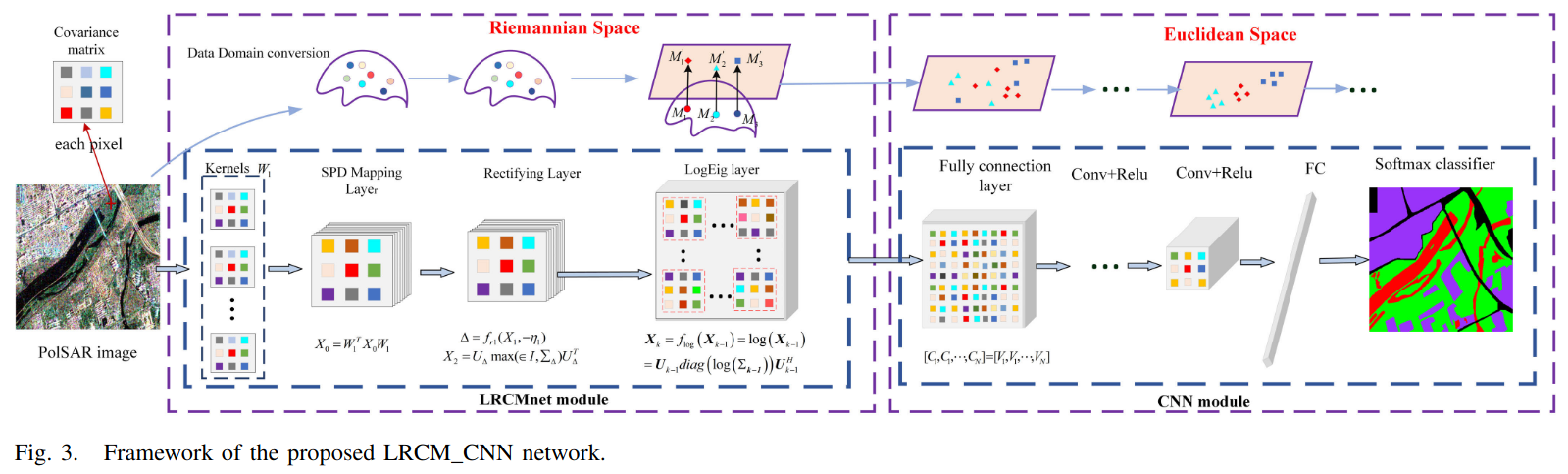
However, what matters is their architecture which from the title they say they are using Riemannian convolution, however, that is not true. In fact, they are simply using BiMap (ReEig and LogEig) and considering that BiMap is some form of convolution. Maybe true, but not what you would imagine.
- What is happening in the LogEig layer? Are they pushing all the covariance matrix from the image into the Tangent space, then vectorizing each and then concatenating the data with one vector por row to make the big matrix used in the CNN module?
Oh, I finally got it. The LogEig generates a vector for each CM (covariance matrix). The fully-connected layer operates on each of these, if it has hidden units, then the output of each is gonna be . With this, the entire PolSAR image (Height Width) is constructed with the features, so the input to the convolution layer is where . And so on and so forth, since the output from the softmax is gonna have a value for each pixel.
This paper is decently written, seem like a valuable application. However, that whole BiMap issue (calling it convolution), just do not sit well for me. Even with the paper great results, it just seems weird.