Introducing Region Based Pooling for handling a varied number of EEG channels for deep learning models (2024)
Open in webOpen in zoteroOpen pdf
1 Abstract
A challenge when applying an artificial intelligence (AI) deep learning (DL) approach to novel electroencephalography (EEG) data, is the DL architecture’s lack of adaptability to changing numbers of EEG channels. That is, the number of channels cannot vary neither in the training data, nor upon deployment. Such highly specific hardware constraints put major limitations on the clinical usability and scalability of the DL models.
In this work, we propose a technique for handling such varied numbers of EEG channels by splitting the EEG montages into distinct regions and merge the channels within the same region to a region representation. The solution is termed
For the 32-channel system version, the mean AUC values across the folds were: RBP (93.34%), spherical spline interpolation (93.36%), and zero-filling (76.82%). Similarly, on the 65-channel system version, the performances were: RBP (93.66%), spherical spline interpolation (93.50%), and zero-filling (85.58%). Finally, the 129-channel system version produced the following results: RBP (94.68%), spherical spline interpolation (93.86%), and zero-filling (91.92%).
In conclusion, RBP obtained similar results to spherical spline interpolation, and superior results to zero-filling. We encourage further research and development of DL models in the cross-dataset setting, including the use of methods such as RBP and spherical spline interpolation to handle a varied number of EEG channels.
2 NOTES
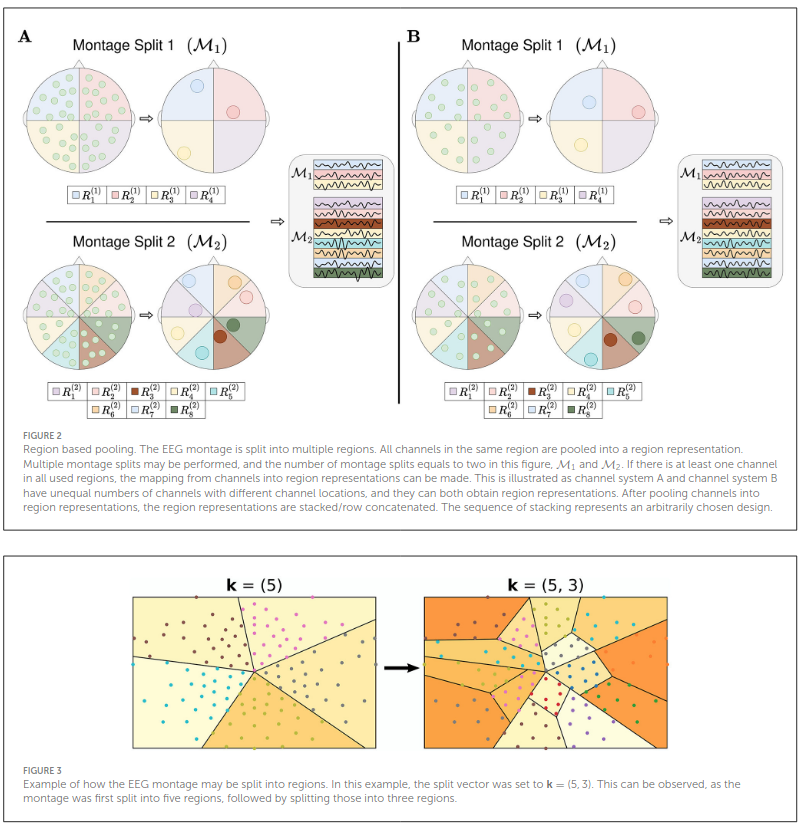
In this paper the authors propose a method to reduce the number of EEG channels based on a region pooling of the brain. This is interesting as this can enable cross-dataset without selecting certain channels and ignoring others, instead they are all somehow used. The initial idea is simple, let all channels positions be mapped to 2D coordinates. Thereafter, the centroid of the channels positions is calculated, and a random angle is generated. Then, split into equally sized regions from the center. The size of the regions can then be considered the number of channels, since they all those in each region are going to be pooled into a single one. For all newly generated regions the same procedure is repeated, where you then rage regions, then , and etc until you are satisfied, the following two figures show it clearly. The most complicated part is on how to choose the pooling operator. The authors propose using average, or channel attention, or continuous channels attention, or
region based pooling with head region, but only this last one uses head regions. For their experiment they used a dataset with 129 electrodes, and tried varying it to 32, 65 and 129, using their method (RBP - Region Based Pooling) against Zero-Filling and Spherical Spline Interpolation. The results show that both RBP and Interpolation have similar results, with the second being best in lower resolution and RBP better in higher resolutions, while Zero-Filling was much worse than both. Overall this is a very much interesting method and might work very well for many datasets with lots of channels, don’t know for sure when using one with many and another with something from 3~15 channels, still, very good.
Impact of Number of Electrodes
[…] evidence from clinical neurology research suggests that the number of channels used during EEG recording may have a significant impact on the data’s ability to capture spatially limited phenomena. (p.2)