Deep Riemannian Neural Architectures for Domain Adaptation in Burst cVEP-based Brain Computer Interface (2024)
Open in webOpen in zoteroOpen pdf
1 Abstract
Code modulated Visually Evoked Potentials (cVEP) is an emerging paradigm for Brain-Computer Interfaces (BCIs) that offers reduced calibration times. However, cVEP-based BCIs still encounter challenges related to cross-session/subject variabilities. As Riemannian approaches have demonstrated good robustness to these variabilities, we propose the first study of deep Riemannian neural architectures, namely SPDNets, on cVEP-based BCIs. To evaluate their performance with respect to subject variabilities, we conduct classification tasks in a domain adaptation framework using a burst cVEP open dataset. This study demonstrates that SPDNet yields the best accuracy with single-subject calibration and promising results in domain adaptation.
2 NOTES
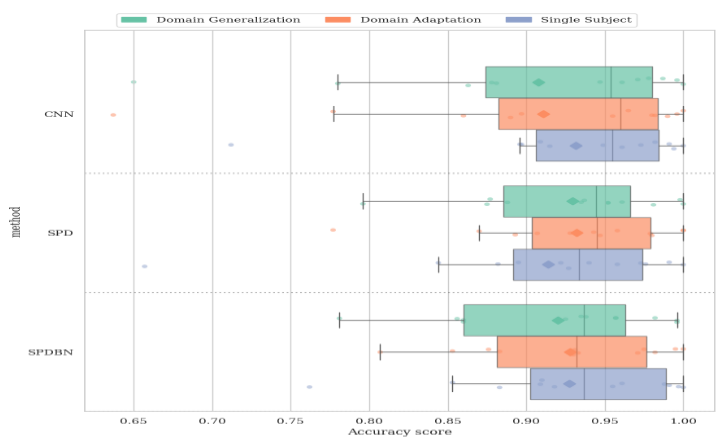
In this paper the authors propose the use of SPDBNNet (with 3 layer of Bimap-ReEig) for the classification of data from a cVEP datasets, in two settings: Domain Generalization (DG) and Domain Adaptation (DA). The most interesting aspect in here is the short length of the extracted EEG window, only 0.25s. They are using a dataset with 32-electrodes and sampling rate of 500 Hz, but bandpass filtered between 1-25 Hz, thus, taking the Nyquist frequency a down sample to 50 Hz would make the covariance matrices rank-deficient. They do not mention anything about it, so they probably kept the 500 Hz, which is expected as the window is short this will still be pretty fast to calculate and keep in memory. However, for even faster inference they could consider down sampling it to 100 Hz and then using it, since they mention it takes 1.438 second for a prediction (0.02 seconds faster than the CNN they compare against). Their results showed that SPDBNNet achieved better accuracy in Single Subject (SS) evaluation, but worse in the other two cases. However, both CNN and SPDNet achieved a better accuracy in DA than in SS/DG, which is weird. Although CNN had many outlier, it had the most stable mean accuracy. It is a simple but interesting paper, especially since there were no other paper applying SPDNet to cVEP.