How Much Data is Enough? Optimization of Data Collection for Artifact Detection in EEG Recordings (2024)
Open in webOpen in zoteroOpen pdf
1 Abstract
Objective. Electroencephalography (EEG) is a widely used neuroimaging technique known for its cost-effectiveness and user-friendliness. However, various artifacts, particularly biological artifacts like Electromyography (EMG) signals, lead to a poor signal-to-noise ratio, limiting the precision of analyses and applications. The currently reported EEG data cleaning performance largely depends on the data used for validation, and in the case of machine learning approaches, also on the data used for training. The data are typically gathered either by recruiting subjects to perform specific artifact tasks or by integrating existing datasets. Prevailing approaches, however, tend to rely on intuitive, concept-oriented data collection with minimal justification for the selection of artifacts and their quantities. Given the substantial costs associated with biological data collection and the pressing need for effective data utilization, we propose an optimization procedure for data-oriented data collection design using deep learning-based artifact detection. Approach. We apply a binary classification between artifact epochs (time intervals containing artifacts) and non-artifact epochs (time intervals containing no artifact) using three different neural architectures. Our aim is to minimize data collection efforts while preserving the cleaning efficiency. Main results. We were able to reduce the number of artifact tasks from twelve to three and decrease repetitions of isometric contraction tasks from ten to three or sometimes even just one. Significance. Our work addresses the need for effective data utilization in biological data collection, offering a systematic and dynamic quantitative approach. By providing clear justifications for the choices of artifacts and their quantity, we aim to guide future studies toward more effective and economical data collection in EEG and EMG research.
2 NOTES
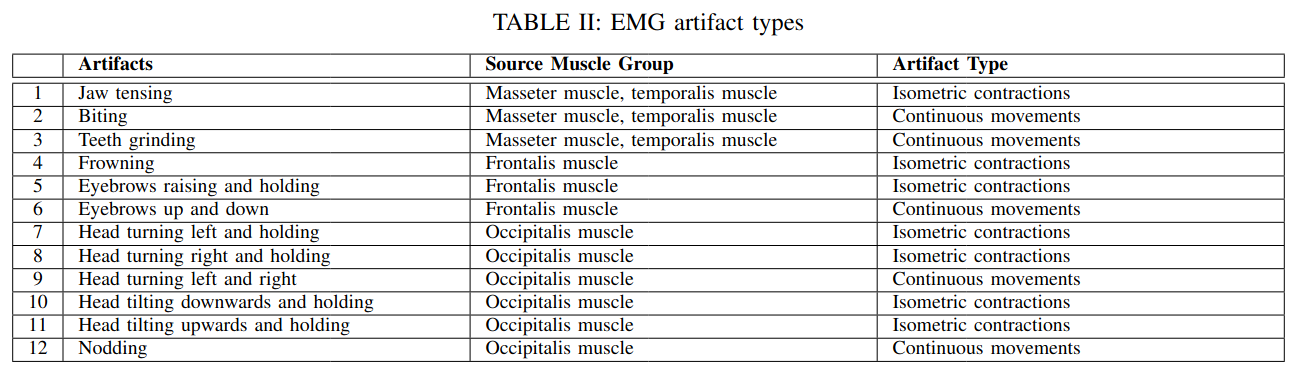
In this paper the authors construct and experiment, and latter they classify it, where artifacts are intentionally introduced. In details: the subjects have to execute 12 actions which introduce 12 (obviously) different EMG artifacts (as shown in Table II bellow), and in another section of the experiment they simply have to rest with their eyes open. The idea is then to try to identify those artifacts solely based on the EEG data. They also did continuous movements, which lasted for a longer time than the simple contractions. After many classification experiments they found that three artifacts are indeed relevant: jaw tensing, frowning and eyebrows raising and holding. The authors were not substantial or couldn’t be effectively extracted from the EEG data. Also, around 3 repetitions of these movements are enough for the classifier to be able to learn them (a reduction from 10 that they set initially). The results are badly shown, but when using those three isometric contractions it is clear that the recall/sensitivity gets better. So, I wonder if starting to record data from subjects with these initial contractions would be good for calibration, specially since these are fast to execute (around 5 seconds each in this case) and easy on the subjects, as none require moving large parts of the body. Cool paper, cool experiment but awful visualizations (even if they look cool). ALSO, WHERE IS THE DATASET??? REFERENCE GOES NOT NOWHERE!