Enhancing ERD Activation and Functional Connectivity via the Sixth-Finger Motor Imagery in Stroke Patients (2024)
Open in webOpen in zoteroOpen pdf
1 Abstract
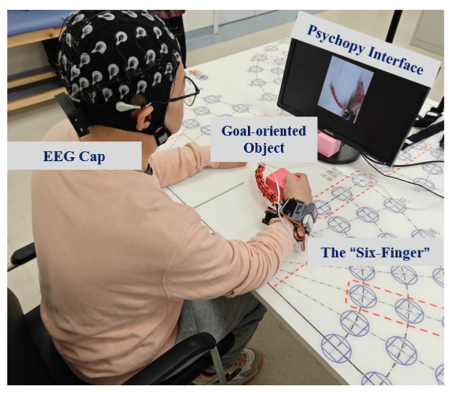
Motor imagery (MI) is widely employed in stroke rehabilitation due to the event-related desynchronization (ERD) phenomenon in sensorimotor cortex induced by MI is similar to actual movement. However, the traditional BCI paradigm, in which the patient imagines the movement of affected hand (AH-MI) with a weak ERD caused by the damaged brain regions, retards motor relearning process. In this work, we applied a novel MI paradigm based on the “sixth-finger” (SF-MI) in stroke patients and systematically uncovered the ERD pattern enhancement of novel MI paradigm compared to traditional MI paradigm. Twenty stroke patients were recruited for this experiment. Event-related spectral perturbation was adopted to supply details about ERD. Brain activation region, intensity and functional connectivity were compared between SF-MI and AH-MI to reveal the ERD enhancement performance of novel MI paradigm. A “wider range, stronger intensity, greater connection” ERD activation pattern was induced in stroke patients by novel SF-MI paradigm compared to traditional AH-MI paradigm. The bilateral sensorimotor and prefrontal modulation was found in SF-MI, which was different in AH-MI only weak sensorimotor modulation was exhibited. The ERD enhancement is mainly concentrated in mu rhythm. More synchronized and intimate neural activity between different brain regions was found during SF-MI tasks compared to AH-MI tasks. Classification results (>80% in SF-MI vs. REST) also indicated the feasibility of applying novel MI paradigm to clinical stroke rehabilitation. This work provides a novel MI paradigm and demonstrates its neural activation-enhancing performance, helping to develop more effective MI-based BCI system for stroke rehabilitation.
2 NOTES
In this paper the authors use ERD activation to classify the data from a new Motor Imagery paradigm based on the introduction of a sixth finger. The idea here is that some subjects who suffered from a stroke, for instance, became unable to move certain fingers, however, by introduction a new finger they should (based on previous research) be capable to learn new neural paths to control it, therefore turning into a “sixth finger” for the subject. Honestly, this idea is incredible interesting, even if neural plasticity degrades over time, the literature has shown that they can learn this new finger. The only problem in their experiment is that subjects used this for only two days. The authors show a high accuracy in predicting its usage, but it is probably from something else, it should take a much longer time for the subjects to really learn and develop the neural paths. Still, cool stuff.