Revisiting euclidean alignment for transfer learning in EEG-based brain-computer interfaces (2025)
Open in webOpen in zoteroOpen pdf
1 Abstract
Due to the non-stationarity and large individual differences of EEG signals, EEG-based brain-computer interfaces (BCIs) usually need subject-specific calibration to tailor the decoding algorithm for each new subject, which is time-consuming and user-unfriendly, hindering their real-world applications. Transfer learning (TL) has been extensively used to expedite the calibration, by making use of EEG data from other subjects/sessions. An important consideration in TL for EEG-based BCIs is to reduce the data distribution discrepancies among different subjects/session, to avoid negative transfer. Euclidean alignment (EA) was proposed in 2020 to address this challenge. Numerous experiments from 10 different BCI paradigms demonstrated its effectiveness and efficiency. This paper revisits the EA, explaining its procedure and correct usage, introducing its applications and extensions, and pointing out potential new research directions. It should be very helpful to BCI researchers, especially those who are working on EEG signal decoding.
2 NOTES
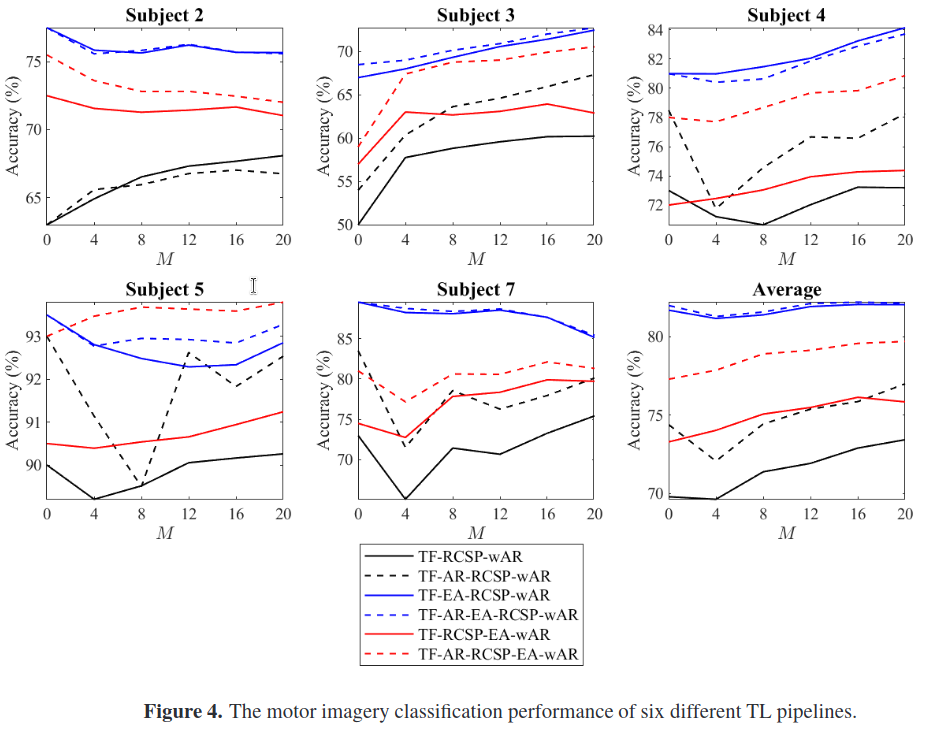
The paper is mainly a review of Euclidean Alignment (EA) by one of its authors. Since 2020, when proposed, it has been applied to many paradigms, as discussed by the authors. It is interesting that they mention Label Alignment (LA), a similar technique but which uses labels instead of being unsupervised as EA is, and they even mention that LA is better, obviously since it uses the label. Still, as quoted many times from @junqueiraSystematicEvaluationEuclidean2024, it is said that EA should be a standard pre-processing step when training cross-subject models. The main point of the paper is showing that EA should be placed between temporal filtering (TF) and spatial filtering (RCSP in this case) in motor imagery bases BCIs. Also, performing average re-referencing (AR) immediately after temporal filtering (right before EA) can further improve the performance. Overall, is is a simple paper and does not bring anything new, but is not irrelevant as they reach their object, which is to talk about EA and its usefulness.