Spectral meta-learner for regression (SMLR) model aggregation: Towards calibrationless brain-computer interface (BCI) (2016)
Open in webOpen in zoteroOpen pdf
1 Abstract
To facilitate the transition of brain-computer interface (BCI) systems from laboratory settings to real-world application, it is very important to minimize or even completely eliminate the subject-specific calibration requirement. There has been active research on calibrationless BCI systems for classification applications, e.g., P300 speller. To our knowledge, there is no literature on calibrationless BCI systems for regression applications, e.g., estimating the continuous drowsiness level of a driver from EEG signals. This paper proposes a novel spectral meta-learner for regression (SMLR) approach, which optimally combines base regression models built from labeled data from auxiliary subjects to label offline EEG data from a new subject. Experiments on driver drowsiness estimation from EEG signals demonstrate that SMLR significantly outperforms three state-of-the-art regression model fusion approaches. Although we introduce SMLR as a regression model fusion in the BCI domain, we believe its applicability is far beyond that.
2 NOTES
The idea is straightforward, modify the Spectral Meta-Learner so that I can work for regression, as the following paragraph explains:
We first use labeled data from the other 14 subjects to build 14 base ridge regression (RR) models, feed the unlabeled data from the 15th subject into them, and then use different model fusion approaches to aggregate the 14 RR models to get the final predictions.
Honestly, the way the results are represented is awful, I can be sure what they really mean, so it is not good overall.
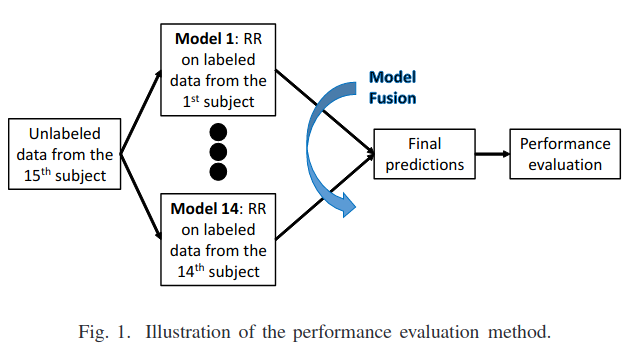
RR: ridge regression