Optimizing Food Taste Sensory Evaluation Through Neural Network-Based Taste Electroencephalogram Channel Selection (2024)
Open in webOpen in zoteroOpen pdf
1 Abstract
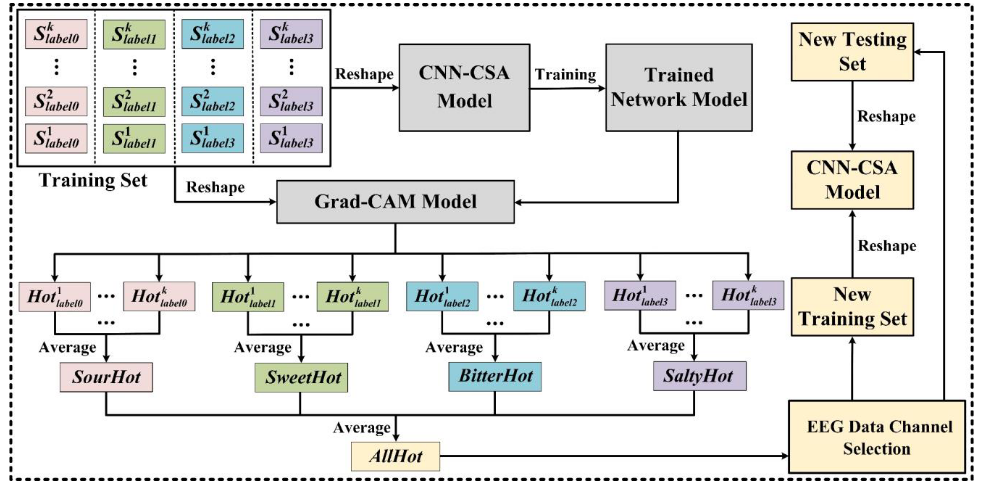
The taste electroencephalogram (EEG) evoked by the taste stimulation can reflect different brain patterns and be used in applications such as sensory evaluation of food. However, considering the computational cost and efficiency, EEG data with many channels has to face the critical issue of channel selection. This paper proposed a channel selection method called class activation mapping with attention (CAM-Attention). The CAM-Attention method combined a convolutional neural network with channel and spatial attention (CNN-CSA) model with a gradient-weighted class activation mapping (Grad-CAM) model. The CNN-CSA model exploited key features in EEG data by attention mechanism, and the Grad-CAM model effectively realized the visualization of feature regions. Then, channel selection was effectively implemented based on feature regions. Finally, the CAM-Attention method reduced the computational burden of taste EEG recognition and effectively distinguished the four tastes. In short, it has excellent recognition performance and provides effective technical support for taste sensory evaluation.
2 NOTES
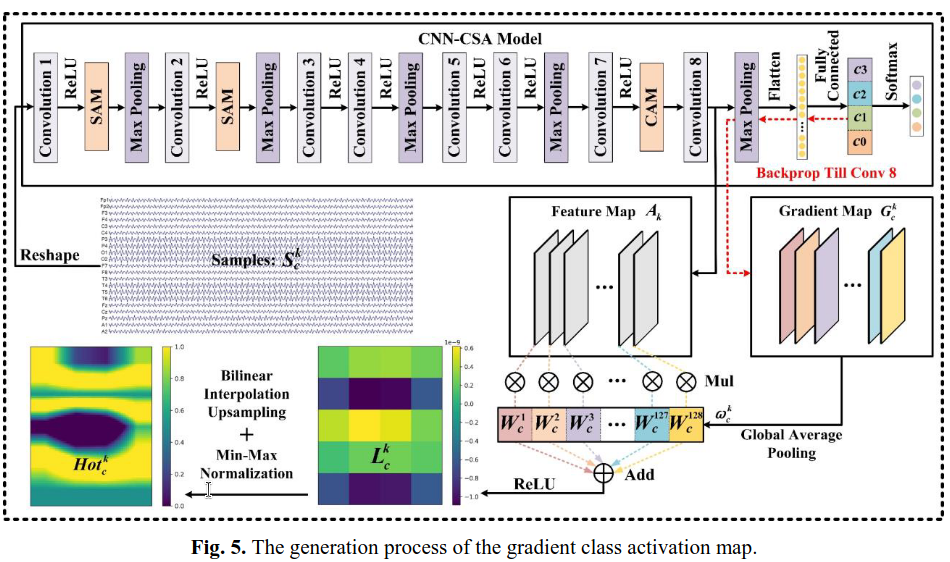
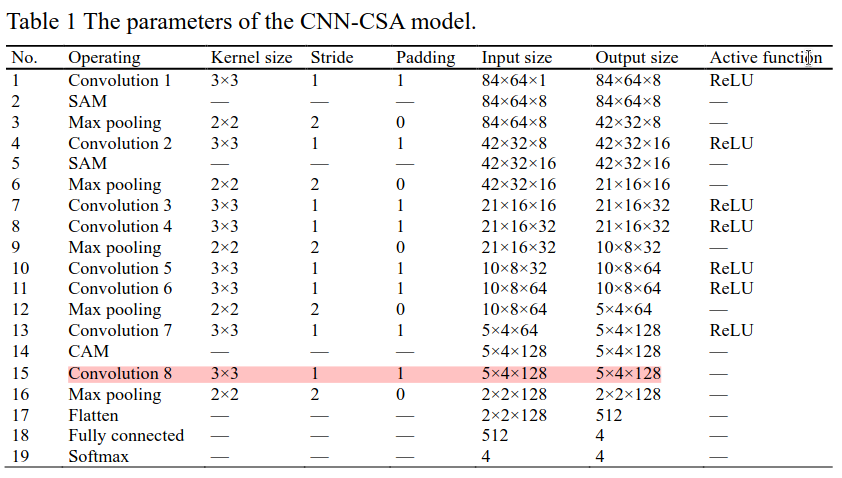
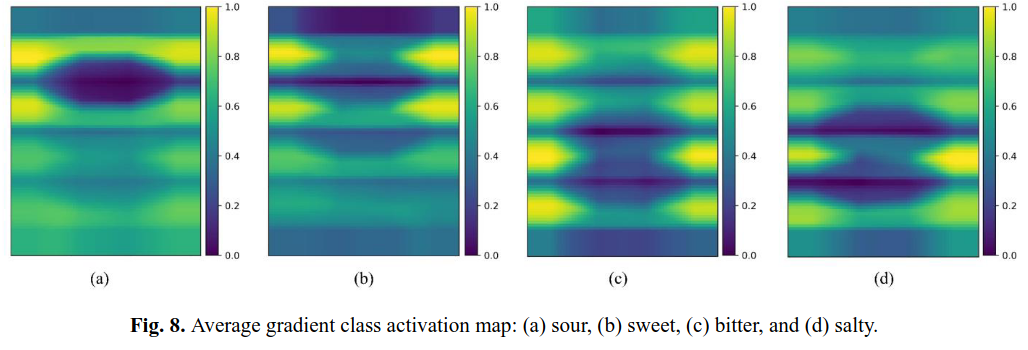
In this paper the authors propose a framework which makes use of two distinct architectures, one for the usual classification and a second use to select the best channels. The classification model (CNN-CSA), is shown in Figure 1, and makes use of two attentions modules, trying to leverage information from spatial domain, with multiple Spatial Attention Modules and by the end the channels information with a Channel Attention Module (CAM). This model is training as usual. The second one, however, is a Grad-CAM model, that takes activation and gradient from the CNN-CSA model in order to locate which were the most informative channels. This information is used to train a final classification module (which I suppose is the CNN-CSA one), that only uses those selected channels. In here the authors used their own datasets, to detect if the subject drank an sour, sweet, bitter or salty drink. The last figure shows that the average gradient class activation map appear to have a distinction on the type of class. The paper could be improved a lot, but still proposes an interesting idea.