Correlation-attention masked temporal transformer for user identity linkage using heterogeneous mobility data (2025)
Open in webOpen in zoteroOpen pdf
1 Abstract
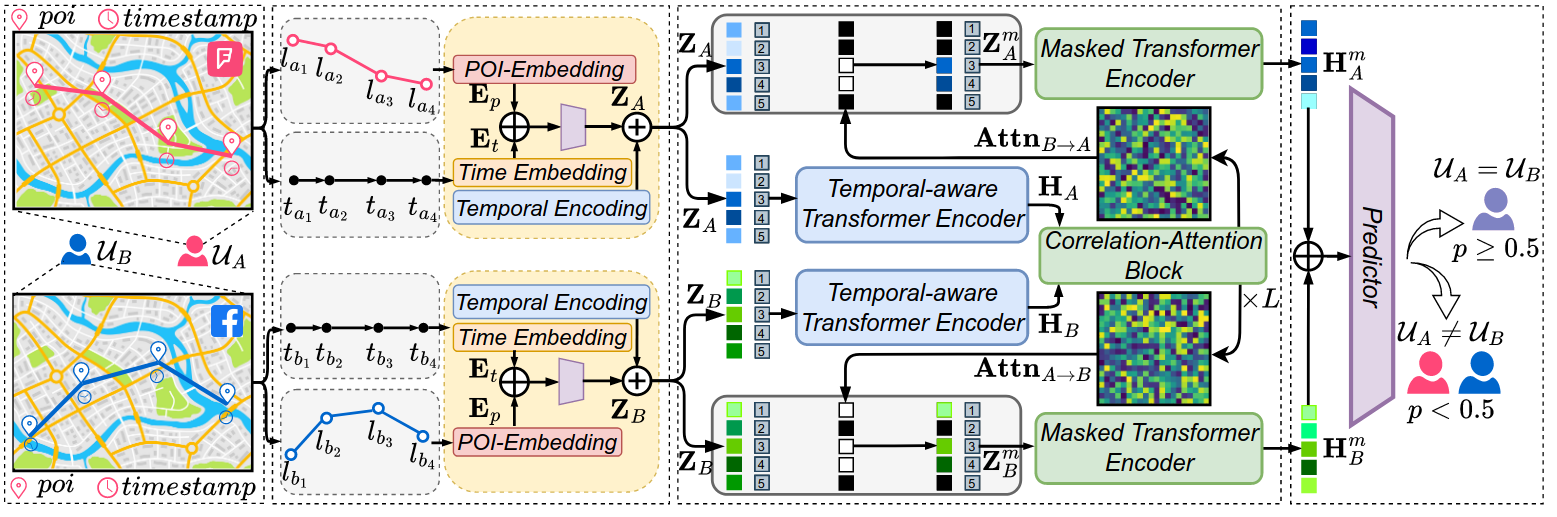
With the rise of social media and Location-Based Social Networks (LBSN), check-in data across platforms has become crucial for User Identity Linkage (UIL). These data not only reveal users’ spatio-temporal information but also provide insights into their behavior patterns and interests. However, cross-platform identity linkage faces challenges like poor data quality, high sparsity, and noise interference, which hinder existing methods from extracting cross-platform user information. To address these issues, we propose a Correlation-Attention Masked Transformer for User Identity Linkage Network (MT-Link), a transformer-based framework to enhance model performance by learning spatio-temporal co-occurrence patterns of cross-platform users. Our model effectively captures spatio-temporal co-occurrence in cross-platform user check-in sequences. It employs a correlation attention mechanism to detect the spatio-temporal co-occurrence between user check-in sequences. Guided by attention weight maps, the model focuses on co-occurrence points while filtering out noise, ultimately improving classification performance. Experimental results show that our model significantly outperforms state-of-the-art baselines by 12.92%~17.76% and 5.80%~8.38% improvements in terms of Macro-F1 and Area Under Curve (AUC).
2 NOTES
The paper itself is based on trying to identify same subjects based on point-of-interest and timestamp. However, the most interesting idea is of using embedding of position with time, and latter a temporal encoding. This could be relevant to using with GeoSPDNet since I could create the windows and set the start and end time to be their time, or something like this. And event the correlation-attention block could be interesting to compare the trajectories on the manifold. Maybe… still a decent paper.