High-fidelity EEG generation: Generative adversarial network highlighting time-frequency-spatial features regulated by global dynamics supervision (2025)
Open in webOpen in zoteroOpen pdf
1 Abstract
Electroencephalogram (EEG) analysis has heavily relied on sophisticated machine learning methods. However, the limited availability of diverse and extensive EEG datasets often underscores the need for reliable data augmentation approaches. This study introduces a new Generative Adversarial Network framework, HiFi-EEG-GAN, consisting of a supervisor, generator, and discriminator, aiming at generating artificial EEG that closely mimics real-world counterparts with “high fidelity” (Hi-Fi). The framework emphasizes two core tasks: 1) Global Dynamics Supervision: The supervisor model distills the global dynamics of real EEG into a Gaussian-like representation. This representation regulates the subsequent EEG generation using Kullback-Leibler (KL) divergence, focusing on macroscopic dynamics; and 2) Hi-Fi EEG Generation: EEG generator replicates real EEG’s time, frequency, and spatial characteristics using a composite architecture. This process is further regulated by another discriminator, focusing on microscopic details. The HiFi-EEG-GAN framework (design validated through ablation study) outperforms state-of-the-art counterparts (e.g., FT-Surrogate, EEG-GAN, BWGAN-GP) in terms of fidelity and diversity in data augmentation. Notable performance metrics include r1NNC (0.88), FID (13.97), and MMD (0.09). In two test cases, classification accuracy improves by 3.2% 6.8% in ASD and 2.5% 8.2% in mental arithmetic tasks, surpassing its counterparts with EEG augmentation by HiFi-EEG-GAN.
2 NOTES
In this paper the authors propose a whole architecture/training process for a GAN applied to EEG data. As can be seen from the figure below, the most Global Dynamics Supervision task. It works essentially in two levels:
- Macroscopic level: focus on minimization of the discrepancy in global dynamics representations between real and artificial EEG;
- Microscopic level: the generative model focuses on producing EEG data with fine-grained probability.
To obtain the global dynamics, what they do is extract some statistical measures from the data (e.g., entropy, power density), and then transform them into a Gaussian-like representation. Each of these measures, which include maximum amplitude, standard deviation, relative power spectrum, mediam frequency index, hjorth complexity, signal entropy and fractal dimension, are not applied directly to the EEG. Instead, they first apply four band-pass filters, extracting data from the bands: delta, theta, alpha, and beta. Therefore, is there are statistics, then the total is gonna be .
Once you can construct these Gaussian-like representation, it is possible to sample values from it which should be similar compared to the real data since it emerged from them. Therefor, to generate synthetic samples the authors sample some values, multiply it by random noise and feed it into the Generator. This will generate a sample that will be fed into Supervisor, to compare with the global dynamics, but also to the Discriminator which will evaluate the signal itself (with a 1D-ResNet classifier).
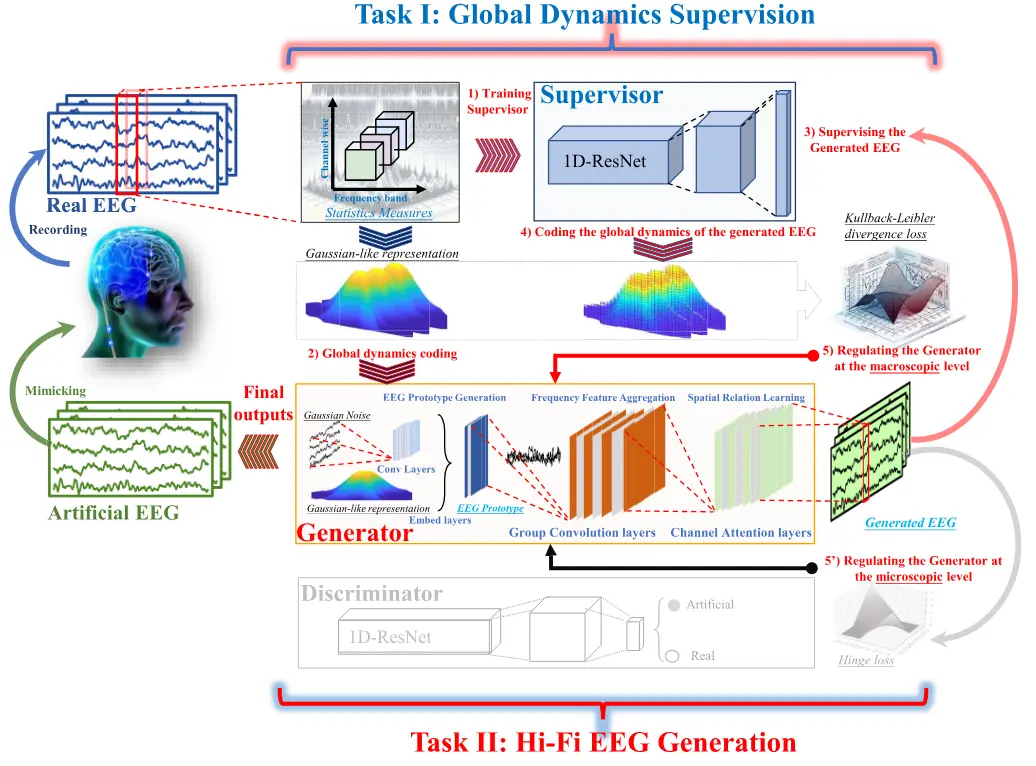
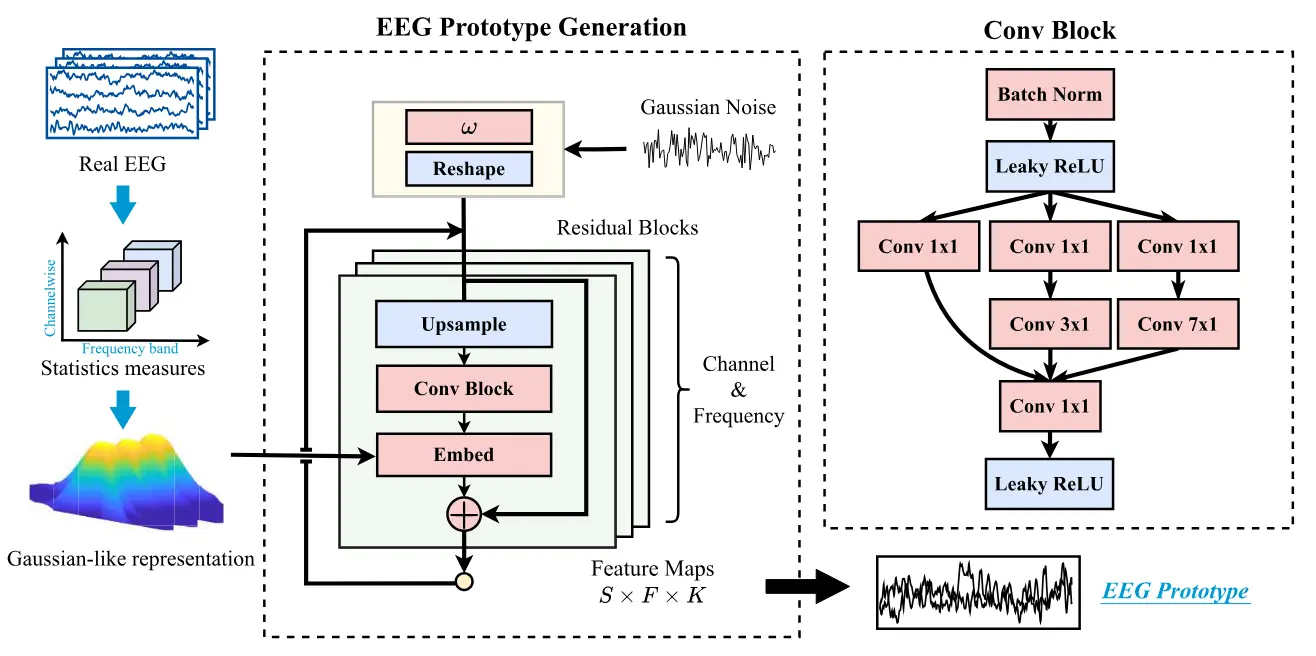
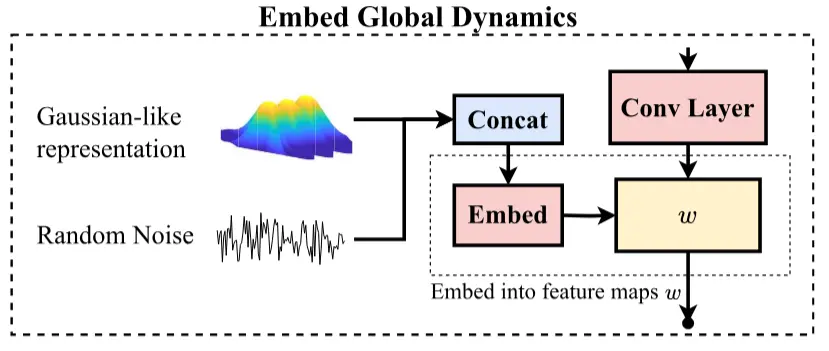
While I did say that the samples dynamics and the noise are used to generate data, it seems from the two figures below (and from what I could somehow understand from the paper) that the dynamics are not used at the beginning. They are actually added at the end of a residual block, so the noise is fed by itself at the beginning. And yes, this seems to be it, see:
Embedding the dynamics (pg. 6)
“An embedding layer is used to embed the global dynamics of real EEG into the tensor , […] the corresponding dynamics code vector is concatenated with random noise vector along the last feature dimension and then transformed by a embed layer to modulate the convolutional layer.”
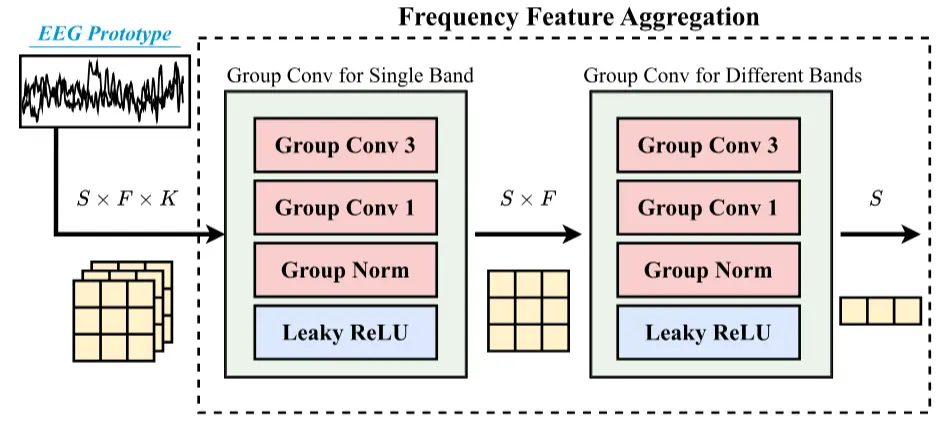
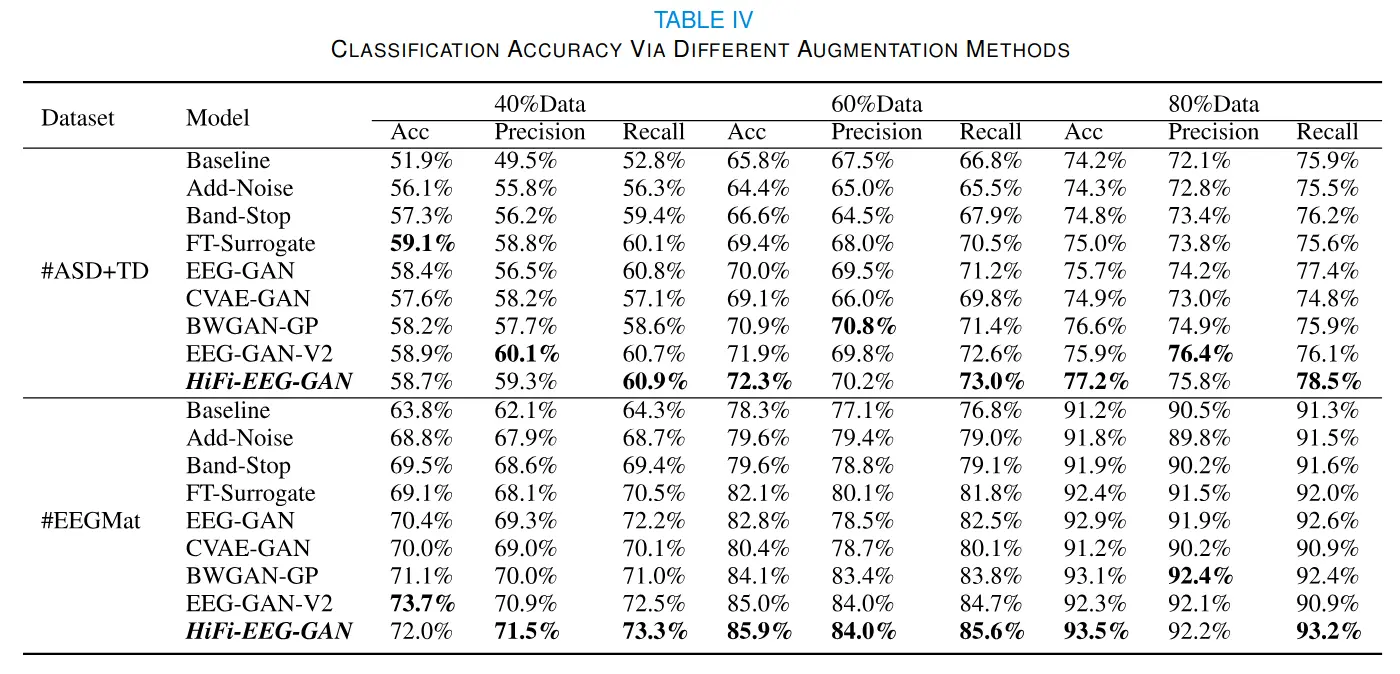
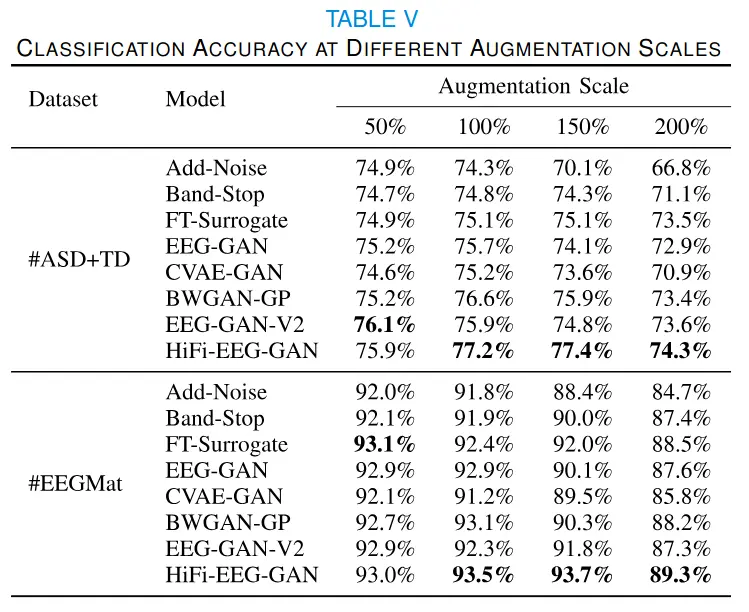
I like a lot the way they present the results. They first consider the case of expanding by 100% the datasets, but training with different quantity of data, and then latter they use the whole training data but augment at different scale. They did not use Generative Adversarial Networks (GAN) > 3.1 Train on Synthetic, Test on Real (TSTR) which is a shame though. Overall, an okay paper, a bit confusing at times and they only release a portion of the code.