T-TIME: Test-time information maximization ensemble for plug-and-play BCIs (2024)
Open in webOpen in zoteroOpen pdf
1 Abstract
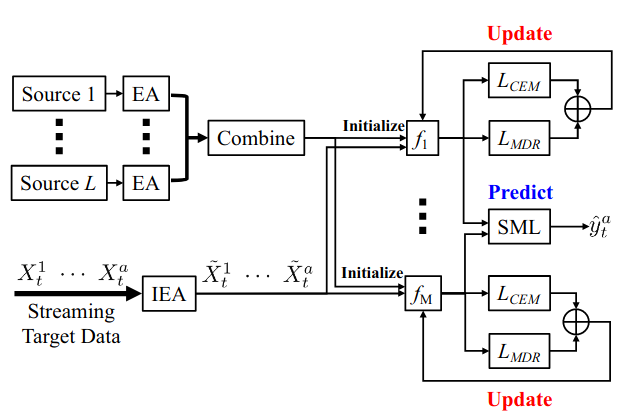
Objective: An electroencephalogram (EEG)-based brain-computer interface (BCI) enables direct communication between the human brain and a computer. Due to individual differences and non-stationarity of EEG signals, such BCIs usually require a subject-specific calibration session before each use, which is time-consuming and user-unfriendly. Transfer learning (TL) has been proposed to shorten or eliminate this calibration, but existing TL approaches mainly consider offline settings, where all unlabeled EEG trials from the new user are available. Methods: This paper proposes Test-Time Information Maximization Ensemble (T-TIME) to accommodate the most challenging online TL scenario, where unlabeled EEG data from the new user arrive in a stream, and immediate classification is performed. T-TIME initializes multiple classifiers from the aligned source data. When an unlabeled test EEG trial arrives, T-TIME first predicts its labels using ensemble learning, and then updates each classifier by conditional entropy minimization and adaptive marginal distribution regularization. Our code is publicized. Results: Extensive experiments on three public motor imagery based BCI datasets demonstrated that T-TIME outperformed about 20 classical and state-of-the-art TL approaches. Significance: To our knowledge, this is the first work on test time adaptation for calibration-free EEG-based BCIs, making plug-and-play BCIs possible.
2 NOTES
In this paper the authors propose an architecture for online evaluation of motor imagery BCIs. They call it Test-Time Adaptation (Online), which seems to be what Pseudo-Online Evaluation is. Essentially, the test sample are gonna come one by one and have to be predicted. To do this their main proposal is around the losses: Conditional Entropy Minimization (CEM) and Adaptive Marginal Distribution Regularization (MDR). They also make use of an Spectral Meta-Learner (SML) for the cases where there are more test trials () than models (). Once again it it said that euclidean alignment should be an essential data pre-processing step in transfer learning. Their use of an assemble is also interesting, they have as many models as sources, but should (optimally) each source be an subject? an session? an dataset? I don’t know, but they consider each source an subject. Also, the losses are the main idea, but usually we are simple using the Cross Entropy Loss or something basic like it, why not try something more complex? It seems to be the direction in transfer learning. Great paper, gave me a lot of interesting questions and they have a nice GitHub repository.