Attention-based convolutional neural network with multi-modal temporal information fusion for motor imagery EEG decoding (2024)
Open in webOpen in zoteroOpen pdf
1 Abstract
Convolutional neural network (CNN) has been widely applied in motor imagery (MI)-based brain computer interface (BCI) to decode electroencephalography (EEG) signals. However, due to the limited perceptual field of convolutional kernel, CNN only extracts features from local region without considering long-term dependencies for EEG decoding. Apart from long-term dependencies, multi-modal temporal information is equally important for EEG decoding because it can offer a more comprehensive understanding of the temporal dynamics of neural processes. In this paper, we propose a novel deep learning network that combines CNN with self-attention mechanism to encapsulate multi-modal temporal information and global dependencies. The network first extracts multi-modal temporal information from two distinct perspectives: average and variance. A shared self-attention module is then designed to capture global dependencies along these two feature dimensions. We further design a convolutional encoder to explore the relationship between average-pooled and variance-pooled features and fuse them into more discriminative features. Moreover, a data augmentation method called signal segmentation and recombination is proposed to improve the generalization capability of the proposed network. The experimental results on the BCI Competition IV-2a (BCIC-IV-2a) and BCI Competition IV-2b (BCIC-IV-2b) datasets show that our proposed method outperforms the state-of-the-art methods and achieves 4-class average accuracy of 85.03% on the BCIC-IV-2a dataset. The proposed method implies the effectiveness of multi-modal temporal information fusion in attention-based deep learning networks and provides a new perspective for MI-EEG decoding. The code is available at https://github.com/Ma-Xinzhi/EEG-TransNet.
2 NOTES
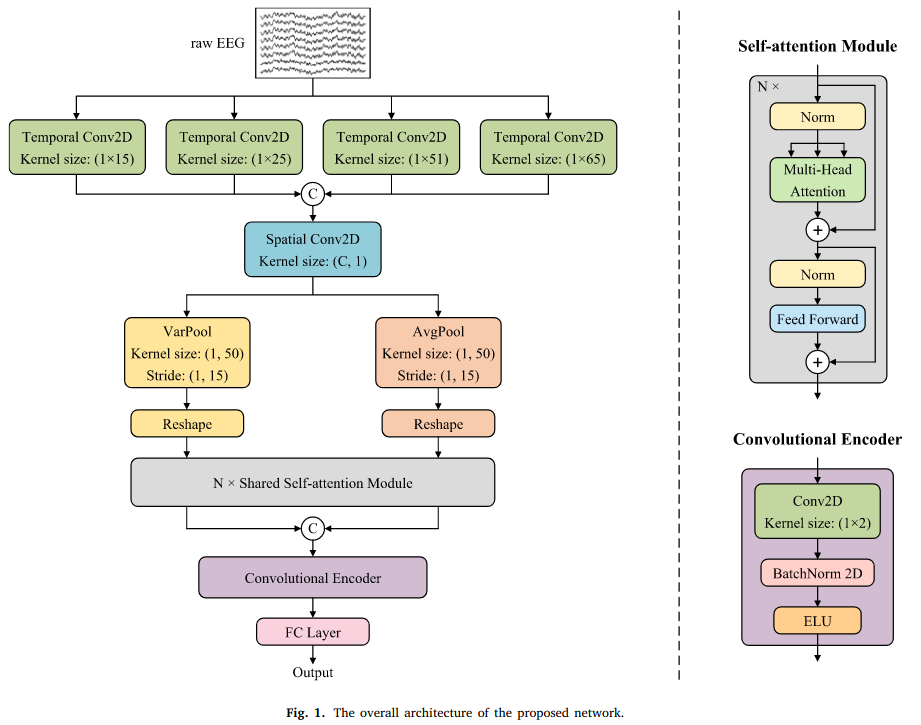
In this paper the authors proposed the architecture shown bellow. It reached of average accuracy in the BCIC-IV-2a dataset, which is incredibly good. However, from their ablation studies, it seems like most of the improvement came with the usage of data augmentation (Segmentation and Reconstruction - S&R), since by removing it the accuracy fell down to . It is still similar to EEGConformer, and higher then FCBNet and EEGNet-8,2, which shows that it is indeed a good architecture, of course. Also, their did an ablation study showing that VarPool is better then AvgPool for every dataset they tested. Overall, I like it, foremost because it shows that using multiple temporal convolution at the beginning is a good approach (since filter bank is know to be effective it is expected, but still valuable). I just wonder why they didn’t concatenate the pooling layers instead of passing each separately to the self-attention module, maybe it doesn’t matter, or maybe it is better so that it focus on different things… The use of the convolutional encoder is weird but curious, since it is meant to kind of mix the VarPool and AvgPool outputs of the self-attention module. Also, they have made their whole code available.