A review of user training methods in brain computer interfaces based on mental tasks (2021)
Open in webOpen in zoteroOpen pdf
1 Abstract
Mental-tasks based brain–computer interfaces (MT-BCIs) allow their users to interact with an external device solely by using brain signals produced through mental tasks. While MT-BCIs are promising for many applications, they are still barely used outside laboratories due to their lack of reliability. MT-BCIs require their users to develop the ability to self-regulate specific brain signals. However, the human learning process to control a BCI is still relatively poorly understood and how to optimally train this ability is currently under investigation. Despite their promises and achievements, traditional training programs have been shown to be sub-optimal and could be further improved. In order to optimize user training and improve BCI performance, human factors should be taken into account. An interdisciplinary approach should be adopted to provide learners with appropriate and/or adaptive training. In this article, we provide an overview of existing methods for MT-BCI user training—notably in terms of environment, instructions, feedback and exercises. We present a categorization and taxonomy of these training approaches, provide guidelines on how to choose the best methods and identify open challenges and perspectives to further improve MT-BCI user training.
2 NOTES
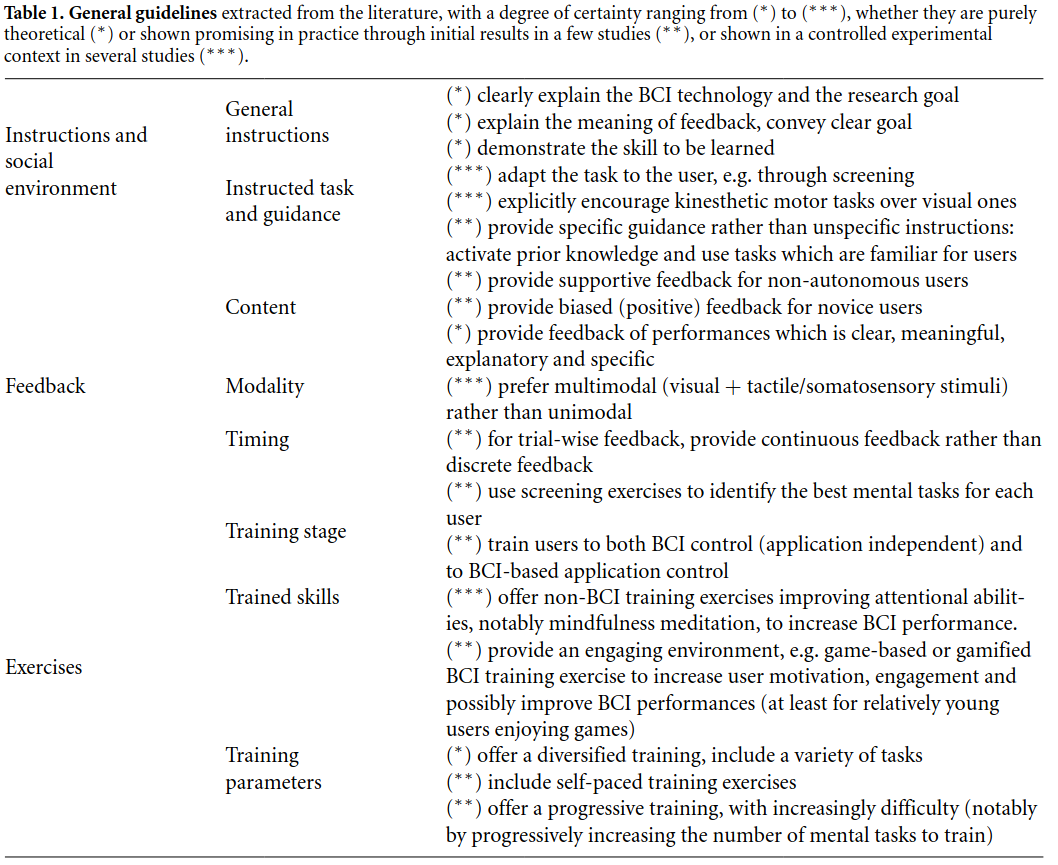
This is a review paper, and poses multiple insights and question on how to construct a brain computer interface. In here, the authors are not worried about the classification of the data, instead, they are worried about the construction of the experiment. Initially, they look at how the environment should be, if the subject should be in contact with other subjects, about the acoustical, thermals, lightning or olfactory comfort, air quality, ergonomics, aesthetics, since these have been show to explain up to 16% of pupils’ academic progress. They also cite some works that show that multiplayer BCI might help the performance and motivation of some subjects. Then, they look at how the instruction should be given. This is important because it could motivate the user, furthermore, the instructions should be to familiar tasks to be better performed. Vague instruction should be avoided, such as instructing the subject to simply perform hand motor imagery, as this could done visually, kinetically, first/third perspective, there are also many different types of movements with different amplitudes and frequency associated to it, so be extremely clear. Then, they looked at feedback, which could be regarding an achieved result (feedback of results) or a deviation from the results (feedback of performance). Either way, literature seems to suggest that feedback is particularly useful for skilled learning who already posses a sufficiently elaborated cognitive model of the task. On the other hand, biased feedback (saying the subject performed better then he really did) benefits novice users but not experts. Something interesting in here, which I never thought about, is when to give the feedback. Should it be by the end of the task (if there is a predefined time)? Or during it? There does not seem to be a clear answer, however, the more frequent the feedback is, the more attentional resources are necessary to process it. Finally, the authors talk about exercises in MT-BCI training. The most interesting thing I noted here was the called ‘goalkeeper paradigm’, introduced with the idea of delivery speed training, which seems to me the obvious goal for all BCI, but the authors talk about many other. However, this is the least informative one, ending with the authors suggesting that the BCI community talk to the Intelligent Tutoring Systems (ITS) community to understand the best exercises for subjects. Overall, a great paper with so many good insights and references, a must-read for anyone building (or thinking of) a BCI system, bellow are the authors final general guidelines for it.