Common Spatial Generative Adversarial Networks based EEG Data Augmentation for Cross-Subject Brain-Computer Interface (2021)
Open in webOpen in zoteroOpen pdf
1 Abstract
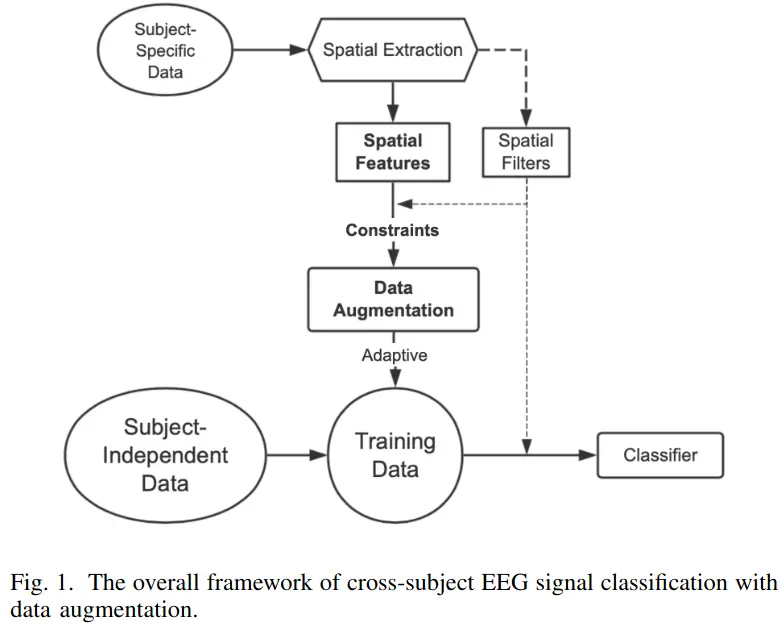
The cross-subject application of EEG-based brain-computer interface (BCI) has always been limited by large individual difference and complex characteristics that are difficult to perceive. Therefore, it takes a long time to collect the training data of each user for calibration. Even transfer learning method pre-training with amounts of subject-independent data cannot decode different EEG signal categories without enough subject-specific data. Hence, we proposed a cross-subject EEG classification framework with a generative adversarial networks (GANs) based method named common spatial GAN (CS-GAN), which used adversarial training between a generator and a discriminator to obtain high-quality data for augmentation. A particular module in the discriminator was employed to maintain the spatial features of the EEG signals and increase the difference between different categories, with two losses for further enhancement. Through adaptive training with sufficient augmentation data, our cross-subject classification accuracy yielded a significant improvement of 15.85% than leave-one subject-out (LOO) test and 8.57% than just adapting 100 original samples on the dataset 2a of BCI competition IV. Moreover, We designed a convolutional neural networks (CNNs) based classification method as a benchmark with a similar spatial enhancement idea, which achieved remarkable results to classify motor imagery EEG data. In summary, our framework provides a promising way to deal with the cross-subject problem and promote the practical application of BCI.
2 NOTES
This is another mostly architecture-wise paper proposal. The main difference is that the authors use Common Spatial Pattern (CSP) to obtain four sub-filter (as there are four categories/classes in the BCI Competition IV Dataset 2a) and then they apply it over the data to generate a ‘Real CS Data’ (that is, a filtered data), and to the same thing to the synthetic EEG data. They then have two modules for the discriminator: one for the “raw” data and another for the “CS” one. I don’t get why this is so relevant, what seems to matter more to me is their two proposed losses:
- cov-loss: it makes the covariance matrix of each generated sample approximate the real samples with where is the mean covariance of a specific class, and are obtained from .
- ev-loss: is designed to enhance the discriminative power of the generated samples. It is calculated as , where represents the largest four eigenvalues obtained after each filter is applied. In Common Spatial Pattern (CSP), larger eigenvalues correspond to a higher variance for one class relative to others, making them easier to distinguish. By using this loss, the generator is forced to create data where the difference between categories is maximized.
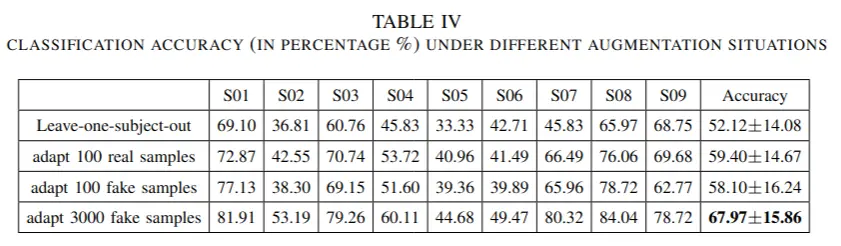
What is weird to me is that they mention that after removing the whole CS-component the accuracy was reduced by 10% while removing any of the losses resulted in around 2%. I expected to be the contrary, so maybe their idea works… Still, the following are their results for the cross-subject evaluation. But I don’t know, latter on they show that on single-subject classification they reached 100% accuracy on subject 9, which leaves me even more skeptical.
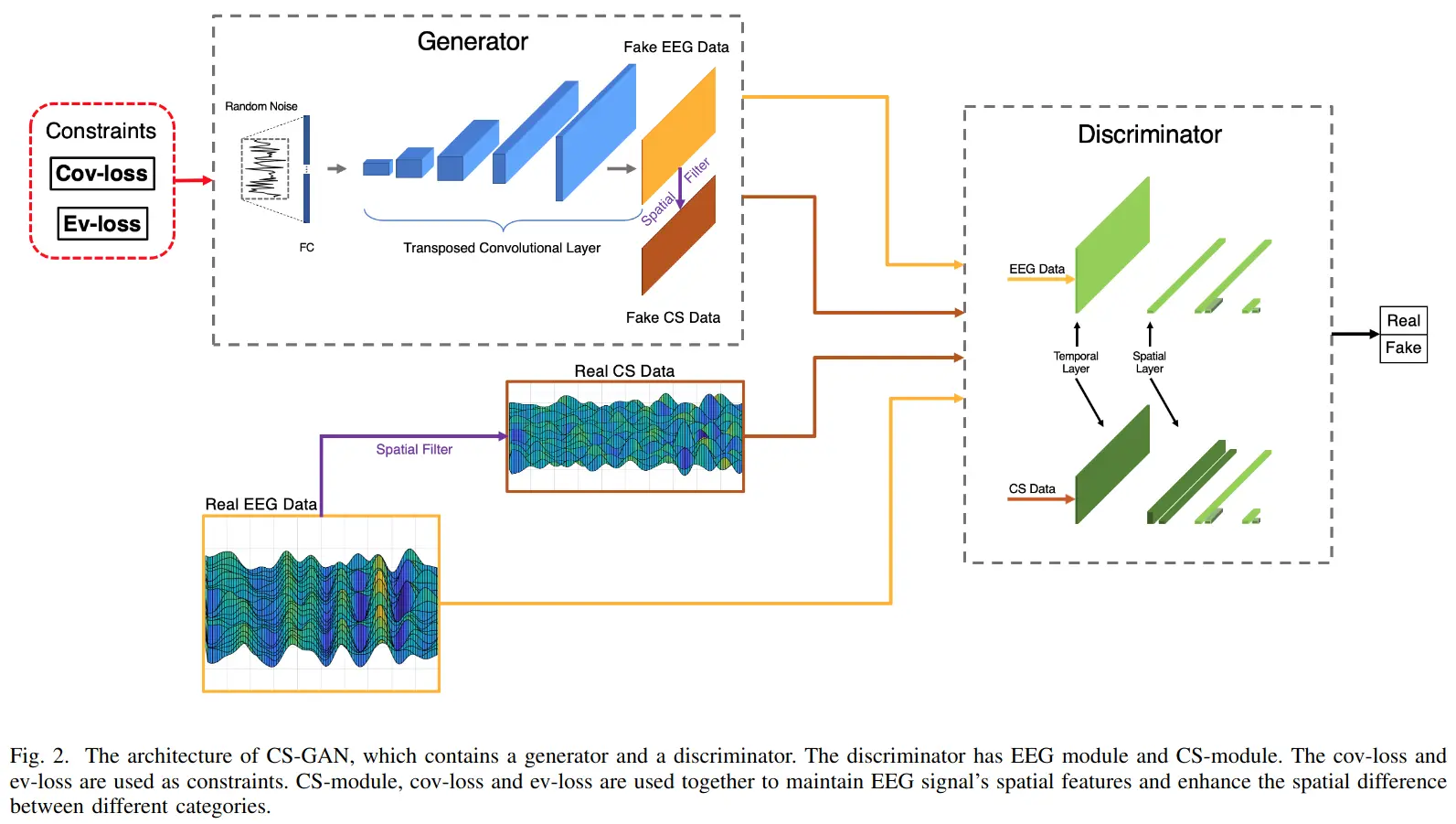
Note that: “The only difference between EEG module and CS-module was that the kernel size of Spatial Conv in EEG module was (channels, 1).”