EEG-DG: A Multi-Source Domain Generalization Framework for Motor Imagery EEG Classification (2024)
Open in webOpen in zoteroOpen pdf
1 Abstract
Motor imagery EEG classification plays a crucial role in non-invasive Brain-Computer Interface (BCI) research. However, the performance of classification is affected by the non-stationarity and individual variations of EEG signals. Simply pooling EEG data with different statistical distributions to train a classification model can severely degrade the generalization performance. To address this issue, the existing methods primarily focus on domain adaptation, which requires access to the test data during training. This is unrealistic and impractical in many EEG application scenarios. In this paper, we propose a novel multi-source domain generalization framework called EEG-DG, which leverages multiple source domains with different statistical distributions to build generalizable models on unseen target EEG data. We optimize both the marginal and conditional distributions to ensure the stability of the joint distribution across source domains and extend it to a multi-source domain generalization framework to achieve domain-invariant feature representation, thereby alleviating calibration efforts. Systematic experiments conducted on a simulative dataset, BCI competition IV 2a, 2b, and OpenBMI datasets, demonstrate the superiority and competitive performance of our proposed framework over other state-of-the-art methods. Specifically, EEG-DG achieves average classification accuracies of 81.79% and 87.12% on datasets IV-2a and IV-2b, respectively, and 78.37% and 76.94% for inter-session and inter-subject evaluations on dataset OpenBMI, which even outperforms some domain adaptation methods. Our code is available at https://github.com/zxchit2022/EEG-DG for evaluation.
2 NOTES
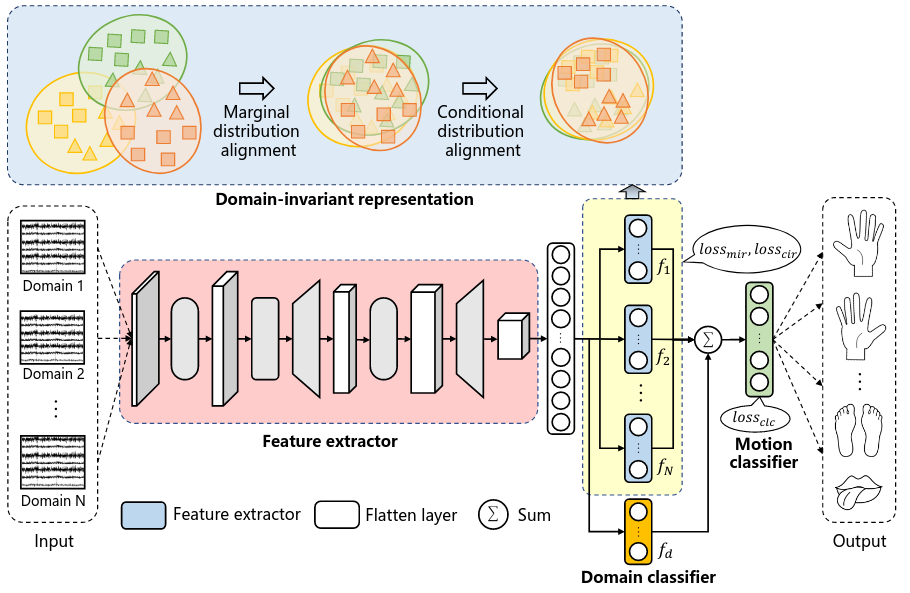
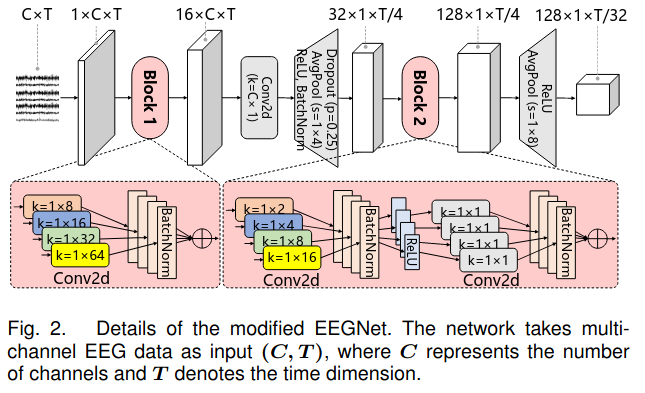
In this paper the authors propose an model for inter-session and inter-subject generalization by focusing on distribution alignment. The architecture they use for it is shown in the following figure. It has a common feature extraction (shown in details in Figure 2), which are then flattened, copied and inputted for each of the classifier (that are as many as the number of domains), it is also inputted into a separate domain classifier. The multiple classifiers are responsible for the marginal-invariant representation loss (), based on Maximum Mean Discrepancy (MMD), to reduce the distribution discrepancy among domains, and the condition-invariant representation loss () is based on distances, reducing the distance between samples of the same class (and same or different domain) while increasing the distance between samples of different classes. The last is the classification loss , that uses a cross-entropy loss function and works as usual. However, they also note that these can’t have the same weight, instead they form a final loss as a combination , where and .
Quotes:
Argument against Domain Adaptation (DA) and in favor o Domain Generalization (DG)
DA methods can effectively address the limitation that machine learning methods cannot overcome the variations but require access to the target EEG data during training, which is impractical in many real-world EEG applications. […] The primary distinction between DA and DG lies in the fact that DA has access to the target domain during training, whereas DG does not. Therefore, DG is more suitable for EEG classification tasks where collecting data in advance poses significant challenges. (pg. 3)
Cross-Session and Cross-Subject Evaluation
For inter-session evaluation, EEG data from the first session were treated as source domains for training, and EEG data from the second session were served as the target domain. We employed the leave-one-subject-out strategy for inter-subject evaluation.