SCDAN: Learning Common Feature Representation of Brain Activation for Intersubject Motor Imagery EEG Decoding (2023)
Open in webOpen in zoteroOpen pdf
1 Abstract
An electroencephalogram (EEG)-based motor imagery (MI) brain–computer interface (BCI) builds a direct communication channel between humans and computers by decoding EEG signals. The intersubject decoding ability is crucial for the application of MI-BCI, which implies that the subject can use MI-BCI equipment without recording additional data for training. Physiologically, because of the distinction in the imagery method, brain structure, and brain state, the intersubject data distribution of MI EEG data is different. This often leads to a partial or even complete failure of the MI decoding algorithm between subjects. To solve these issues, we propose a novel deep learning method called the spatial and conditional domain adaption network (SCDAN), which aims to adapt the intersubject MI EEG data. In SCDAN, three innovative structures are employed: a parallel temporal–spatial convolution feature extractor, a spatial discriminator, and a conditional discriminator. The feature extractor adopts an improved temporal–spatial convolutional network that has a more reasonable structure and fewer parameters to reduce the risk of intersubject overfitting. The spatial discriminator and conditional discriminator calibrate the training processing to help the feature extractor learn the intersubject common feature representation. We evaluate the performance of SCDAN on the GigaScience dataset and the 2a BCI Competition IV dataset using both one-to-one and leave-one-out transfer protocols. For the one-to-one transfer protocol, the classification accuracies of SCDAN improve by 5.70% and 12.43% compared with the baseline method. And for the leave-one-out transfer protocol, the improvements are 8.60% and 15.84%, respectively. The results show a significant improvement compared with the baseline and comparison methods.
2 NOTES
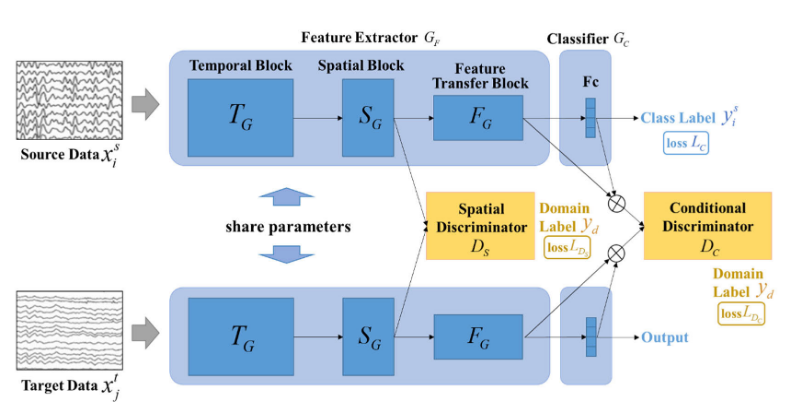
In this paper the authors propose a domain adaptation architecture for EEG data, specifically for motor imagery. They called it Spatial and Conditional Domain Adaptation Network (SCDAN), shown in the figure bellow, which is composed of three innovative structures: a parallel temporal–spatial convolution feature extractor, a spatial discriminator, and a conditional discriminator. However, I did not understand their use of the Spatial and Conditional Discriminator. Do they same the same weights? You pass source data alongside target data? The conditional discriminator idea I understand, they want to select a subset of source samples that are sure to help the target, making the transfer process easier, but not how it works in practice. In conclusion, if this paper had a github link it would be fine, right now it is bad since I doubt anyone would be able to reproduce it and the main ideias are not well explained.
Spatial Discriminator and Conditional Discriminator
[…] the spatial discriminator () calibrates the spatial feature representation extracted by subnetwork between the source domain data () and target domain data (), which indicates that different data domains have a common spatial feature representation. The conditional discriminator () alleviates the possible differences in discriminative feature representation distributions between and , which will decrease the effects of intersubject imagery way differences. The use of and further improves the performance of the classifier on the target subject. (pg.4)