Riemannian Procrustes Analysis: Transfer Learning for Brain–Computer Interfaces (2019)
Open in webOpen in zoteroOpen pdf
1 Abstract
Objective: This paper presents a Transfer Learning approach for dealing with the statistical variability of EEG signals recorded on different sessions and/or from different subjects. This is a common problem faced by Brain-Computer Interfaces (BCI) and poses a challenge for systems that try to reuse data from previous recordings to avoid a calibration phase for new users or new sessions for the same user. Method: We propose a method based on Procrustes analysis for matching the statistical distributions of two datasets using simple geometrical transformations (translation, scaling and rotation) over the data points. We use symmetric positive definite matrices (SPD) as statistical features for describing the EEG signals, so the geometrical operations on the data points respect the intrinsic geometry of the SPD manifold. Because of its geometry-aware nature, we call our method the Riemannian Procrustes Analysis (RPA). We assess the improvement in Transfer Learning via RPA by performing classification tasks on simulated data and on eight publicly available BCI datasets covering three experimental paradigms (243 subjects in total). Results: Our results show that the classification accuracy with RPA is superior in comparison to other geometry-aware methods proposed in the literature. We also observe improvements in ensemble classification strategies when the statistics of the datasets are matched via RPA. Conclusion and significance: We present a simple yet powerful method for matching the statistical distributions of two datasets, thus paving the way to BCI systems capable of reusing data from previous sessions and avoid the need of a calibration procedure.
2 NOTES
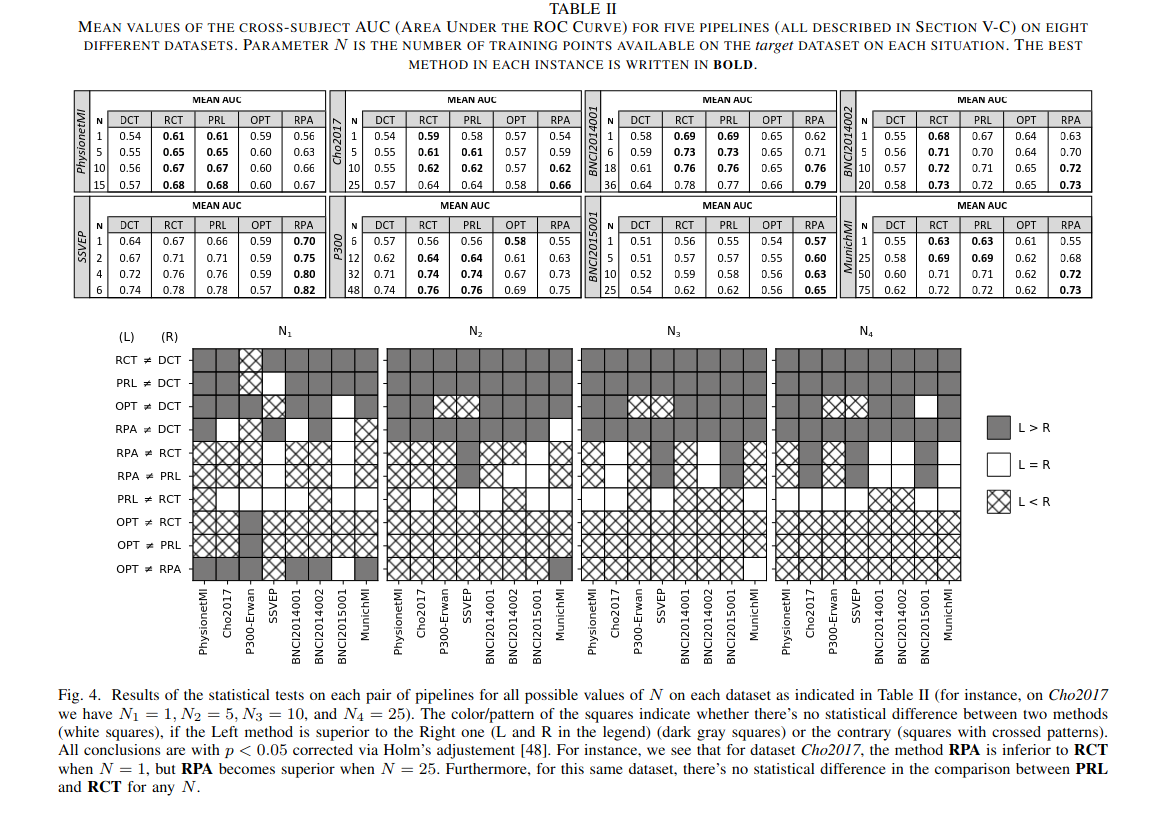
In this paper Pedro expands the use of Riemannian Procrustes Analysis (RPA) for transfer learning data in a cross-subject evaluation setting. The ideia is the same as traditional RPA as far as I can see. The results for the Kalunga2016 and BNCI2015_001 datasets were superior to other methods. But the most interesting thing, to be honest, is the presentation of the results. See both tables bellow, it is very clear what they are showing, first the accuracy in each dataset considering a number of training data available from the target dataset, and in the sequence a comparison off all datasets.