BDAN-SPD: A Brain Decoding Adversarial Network Guided by Spatiotemporal Pattern Differences for Cross-Subject MI-BCI (2024)
Open in webOpen in zoteroOpen pdf
1 Abstract
Although advances in deep learning technologies have greatly facilitated the brain intention decoding from electroencephalogram (EEG) in motor imagery brain–computer interfaces (MI-BCIs), significant individual differences hinder the practical cross-subject MI-BCI applications. Unlike other existing domain adversarial transfer networks that focus on designing different discriminators to reduce individual differences, inspired by the motor lateralization phenomenon, we innovatively utilize transformer and the spatiotemporal pattern differences of EEG as prior knowledge to enhance the feature discriminability in our brain decoding adversarial network. In addition, to address adversarial network decision boundaries bias toward the source domain, we propose a data augmentation method, EEGMix to rapidly mix and enrich the target domain data. With an adaptive adversarial factor, our decoding model reduces the differences in marginal and conditional distribution simultaneously. Three public MI datasets, 2a, 2b, and OpenBMI verified our model’s effectiveness. The accuracy achieved 77.49%, 85.19%, and 79.37%, superior to other state-of-the-art algorithms.
2 NOTES
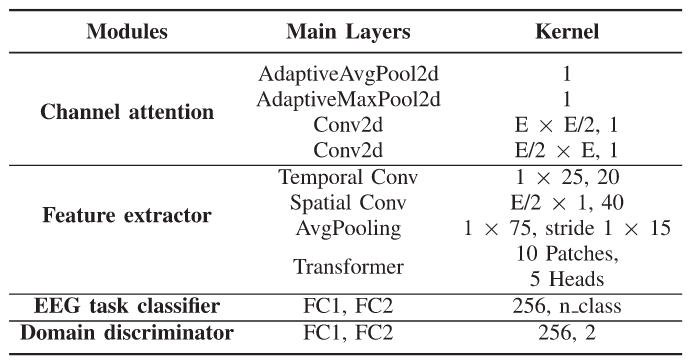
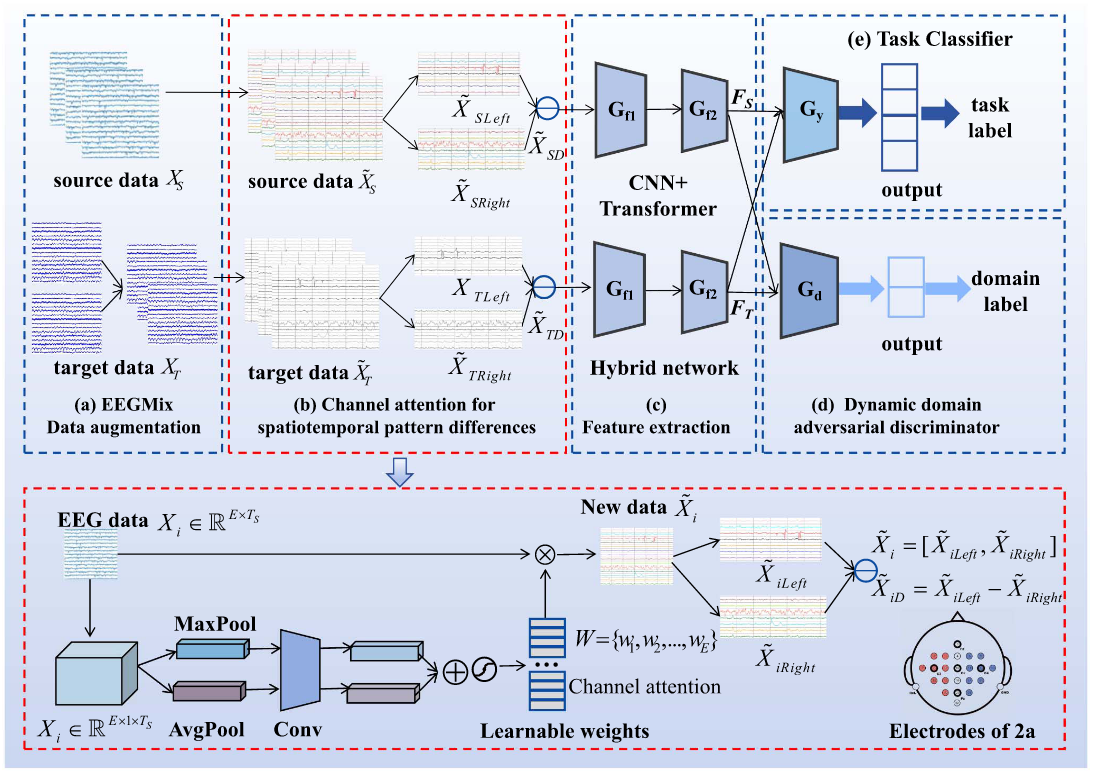
In this paper the authors propose a model which uses spatiotemporal difference (SPD), from the left and right hemispheres, with attention mechanism and domain adaptation for cross-subject evaluation. The idea of separating the electrodes make it so that they have a resulting signal composed of the difference of each hemisphere, as a priori. Their use of attention is also of interesting note, since they make sure the dimensions are in the correct order to identify the importance of different electrodes, and so that the mechanism works effectively. The most relevant part of the paper is (aside the SPD) the brain decoding adversarial network (BDAN). It is composed of a task classifier () and a domain classifier ( - with outputs source or target), such that aims to distinguish subjects in different domains by maximizing the adversarial loss , while (and the feature extractor ) are optimized by minimizing the classification loss . This way, the feature extractor can obtain task-related but domain-invariant features. Then, .